Key points
- Open frame: the number of pins knocked down in two balls (0 to 9).
- Spare (/): 10 + the pins from the next ball.
- Strike (X): 10 + the pins from the next two balls, so a frame is worth 30 points at most.
- In the 10th frame, a strike earns 2 bonus balls and a spare 1 bonus ball.
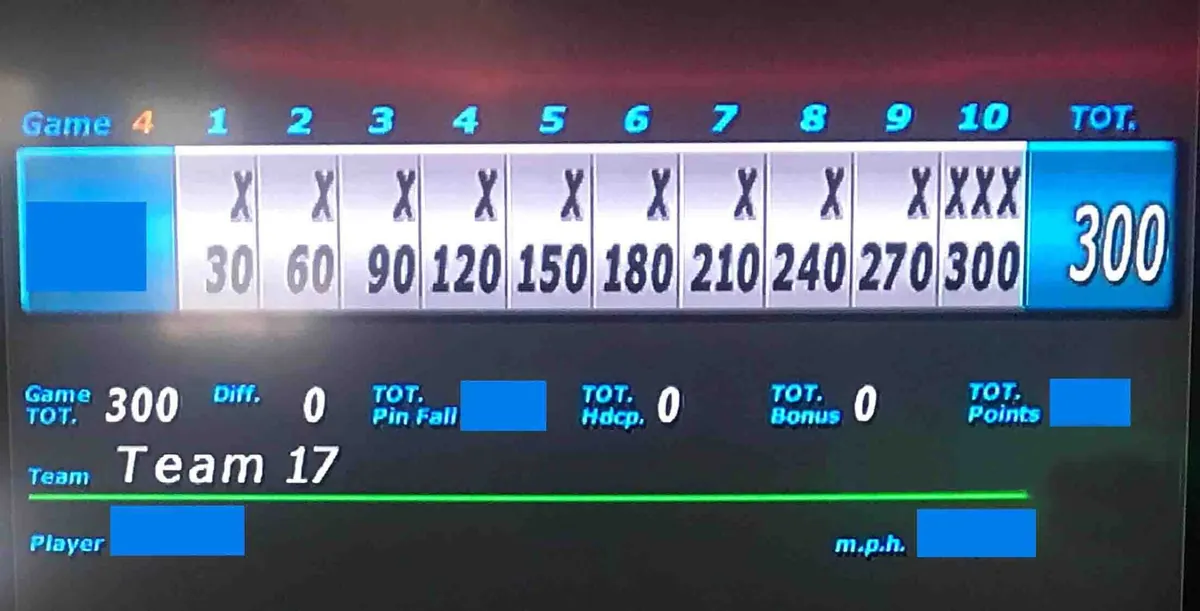
- The maximum score is 300 (12 strikes); a game of X, 7/, 9-, X, -8, 8/, -6, X, X, X81 adds up to 167.
How is a bowling score calculated?
The score of a bowling game is the sum of the points scored in each of the 10 frames, with each frame worth the number of pins knocked down plus any bonuses. These bonuses reward strikes and spares: the pins knocked down on the following balls are counted a second time.
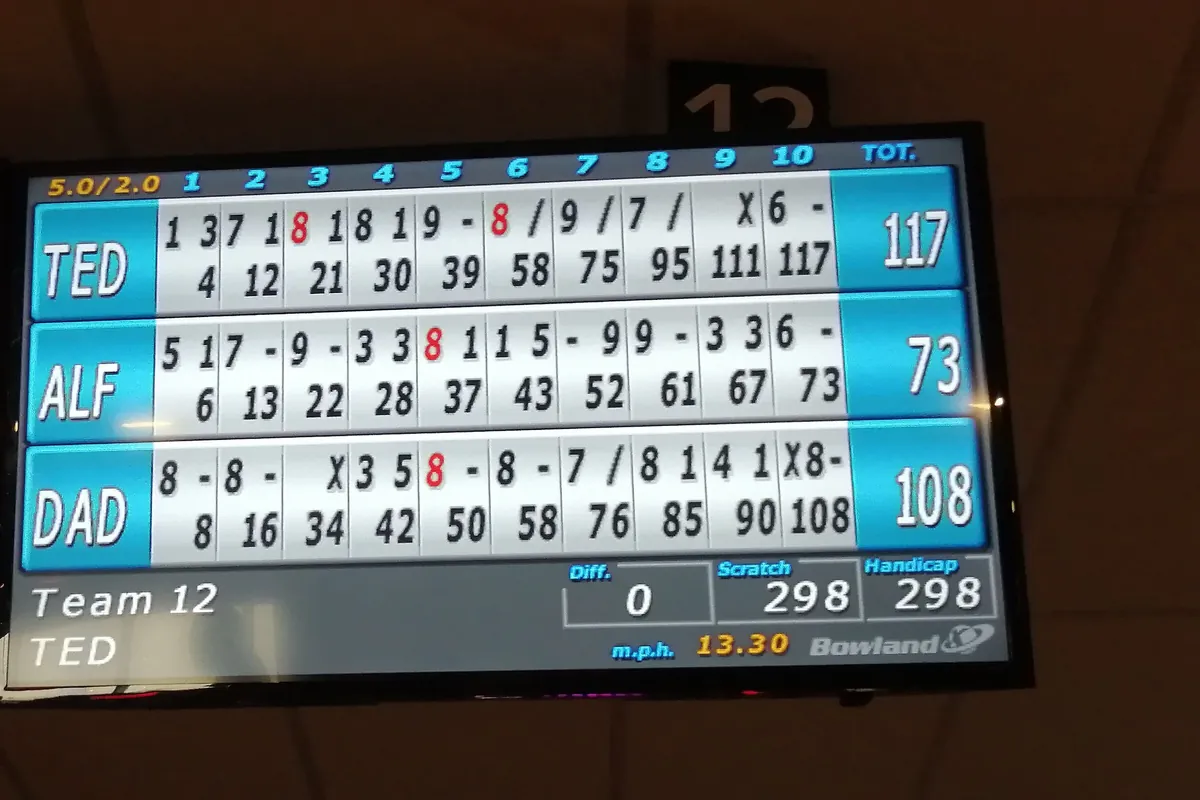
This is why a score doesn't always appear straight away: after a strike, you have to wait for the next two balls to know what the frame is worth. The score displayed is a running total: the box for frame 5 shows the total of frames 1 to 5, not the points for frame 5 alone.
| Result | Symbol | Frame value | Maximum |
|---|---|---|---|
| Open frame | numbers (e.g. 7 2) | pins knocked down | 9 |
| Spare | / | 10 + next ball | 20 |
| Strike | X | 10 + next two balls | 30 |
How many points is a strike worth?
A strike is worth 10 points plus the total number of pins knocked down on the next two balls. You get one by knocking down all 10 pins with the first ball of a frame, which then ends immediately.
- Strike followed by 7 and 2: 10 + 7 + 2 = 19.
- Strike followed by a spare (for example 6 then 4): 10 + 10 = 20.
- Strike followed by two strikes: 10 + 10 + 10 = 30, the maximum value of a frame.
Be careful: you count the next two balls, not the next two frames. After two strikes in a row, the second bonus ball for the first strike is therefore the first ball of the frame after that.
How many points is a spare worth?
A spare is worth 10 points plus the pins knocked down on the next ball. You get one by knocking down all 10 pins with two balls in the same frame.
- Spare followed by an 8 on the first ball of the next frame: 10 + 8 = 18.
- Spare followed by a strike: 10 + 10 = 20.
- Spare followed by a gutter ball: 10 + 0 = 10.
The first ball of the next frame therefore counts twice: once as the spare bonus, and once in its own frame.
How does the 10th frame work?
In the 10th frame, a strike earns two extra balls and a spare one extra ball: these bonus balls are only used to work out the value of that strike or spare. With no strike or spare, the 10th frame is played with two balls like the others.
The 10th frame is therefore worth 30 points at most (X X X). The notation “X81” means: strike, then 8 pins, then 1 pin, i.e. 10 + 8 + 1 = 19 points for the frame. After a strike in the 10th, the pins are reset for the first bonus ball; if that ball is not a strike, the second ball is played at the pins left standing.
How do you read a bowling score sheet?
On a score sheet or screen, each frame has two small boxes for the balls and one large box for the running total. The 10th frame has three.
| Symbol | Meaning |
|---|---|
| X | Strike: 10 pins with the first ball |
| / | Spare: the remaining pins knocked down with the second ball |
| - | No pins knocked down on that ball (a miss or a gutter ball) |
| F | Foul: foul line crossed, 0 points for that ball |
| Circled or coloured number | Split after the first ball |
| G | On some screens: gutter ball |
Worked example: a 167 game
Take the following game: X, 7/, 9-, X, -8, 8/, -6, X, X, X81. It adds up to 167 points, a good score for a regular recreational bowler. Here is the calculation frame by frame.
| Frame | Balls | Calculation | Frame points | Running total |
|---|---|---|---|---|
| 1 | X | 10 + 7 + 3 (the following spare) | 20 | 20 |
| 2 | 7 / | 10 + 9 (1st ball of frame 3) | 19 | 39 |
| 3 | 9 - | 9 + 0, open frame | 9 | 48 |
| 4 | X | 10 + 0 + 8 | 18 | 66 |
| 5 | - 8 | 0 + 8, open frame | 8 | 74 |
| 6 | 8 / | 10 + 0 (1st ball of frame 7) | 10 | 84 |
| 7 | - 6 | 0 + 6, open frame | 6 | 90 |
| 8 | X | 10 + 10 + 10 (strikes in frames 9 and 10) | 30 | 120 |
| 9 | X | 10 + 10 + 8 (strike and 1st bonus ball in frame 10) | 28 | 148 |
| 10 | X 8 1 | 10 + 8 + 1 | 19 | 167 |
Three lessons stand out from this game:
- Frame 8 is worth 30 points because it is followed by two strikes: that is three strikes in a row, a “turkey”.
- Frame 6 (a spare followed by a 0) is worth only 10 points: a good first ball after a spare counts double.
- The three open frames (3, 5 and 7) are costly. With a spare in each of them, the score would easily top 190.
To check a game or practise keeping score, enter your balls in our bowling score calculator: it shows the breakdown frame by frame.
What are the most common scoring mistakes?
The most common mistake is counting the next two frames instead of the next two balls after a strike. After X, 7/, the strike bonus is 7 + 3 = 10, not 7 + 3 + the following ball.
- Forgetting the delayed bonus: after a strike, the frame stays “pending” until the next two balls have been bowled.
- Adding the running total twice: each box already contains the total since frame 1.
- Misreading the 10th frame: the bonus balls are not extra frames, they only complete the 10th.
- Counting a foul: a ball marked F is worth 0, even if pins fell.
Practical case with two strikes in a row: X, X, then 7 and 2. Frame 1 is worth 10 + 10 + 7 = 27 (its next two balls are the strike in frame 2 and the 7 in frame 3). Frame 2 is worth 10 + 7 + 2 = 19. Frame 3, an open frame, is worth 9. The running total displayed is therefore 27, then 46, then 55. Until the 7 has been bowled, the box for frame 1 stays empty: that's normal, as the value of the first strike is not yet known.
What are the benchmark scores in bowling?
The maximum score is 300 (12 strikes in a row), and the minimum is 0. In between, a few benchmarks help you gauge a level:
| Usual score | Approximate level |
|---|---|
| Under 100 | Beginner, occasional outings |
| 100 to 150 | Regular recreational bowler |
| 150 to 190 | Good league bowler |
| 190 to 220 | Experienced bowler, competitor |
| Over 220 | Elite level |
One curiosity nicely illustrates how bonuses work: a game that alternates strikes and spares from start to finish gives exactly 200, a score nicknamed the “Dutch 200”. In a league, you track your average and handicap to measure your progress; in Morocco, the ASBM (Association Sportive du Bowling Marocain, the Moroccan Bowling Sports Association) keeps these statistics for the bowlers in its weekly league. To find out all about the perfect score, read our guide to the perfect 300 game.
Frequently asked questions
How many points is a strike worth in bowling?
A strike is worth 10 points plus the total of the next two balls. It is therefore worth between 10 and 30 points, depending on the balls that follow it.
How many points is a spare worth in bowling?
A spare is worth 10 points plus the pins knocked down on the next ball, i.e. between 10 and 20 points.
How many balls do you get in the 10th frame?
Two balls for an open frame, three for a strike or a spare. The bonus balls are only used to work out the value of the strike or spare.
What does the dash mean on a bowling score sheet?
The dash (-) means that no pins were knocked down on that ball. It is worth 0 points.
How many points do you score by alternating strikes and spares?
A game that alternates strikes and spares across all 10 frames gives exactly 200 points. It is called the Dutch 200.
What is the maximum score in bowling?
The maximum score is 300, achieved with 12 strikes in a row: one in each of the first 9 frames and three in the 10th.