Key points
- A perfect game = 12 strikes in a row = 300 points, the highest possible score.
- Each frame is then worth 30 points: 10 for the strike + the 20 pins from the next two deliveries.
- The first 300 recognised by the American Bowling Congress dates from 1908; the first televised 300, from 1967.
- The 900 series (three perfect games in a row) was not certified for the first time until 1997.
- A single missed shot is enough to break perfection: 11 strikes followed by 9 pins gives 299.
What is a perfect game in bowling?
A perfect game is a game of ten-pin bowling that ends with a score of 300, the highest the rules allow. To get one, you have to knock down all 10 pins on the first delivery of every frame, without a single exception: 9 strikes in frames 1 to 9, then 3 strikes in the 10th frame, i.e. 12 strikes in a row. A foul (crossing the line) or a single pin left standing is enough to break the streak.
It is known as a perfect game, or simply a “300”. It is one of the so-called “honour scores” that federations officially record when it is bowled in a league or a sanctioned tournament.
Why is the highest score 300?
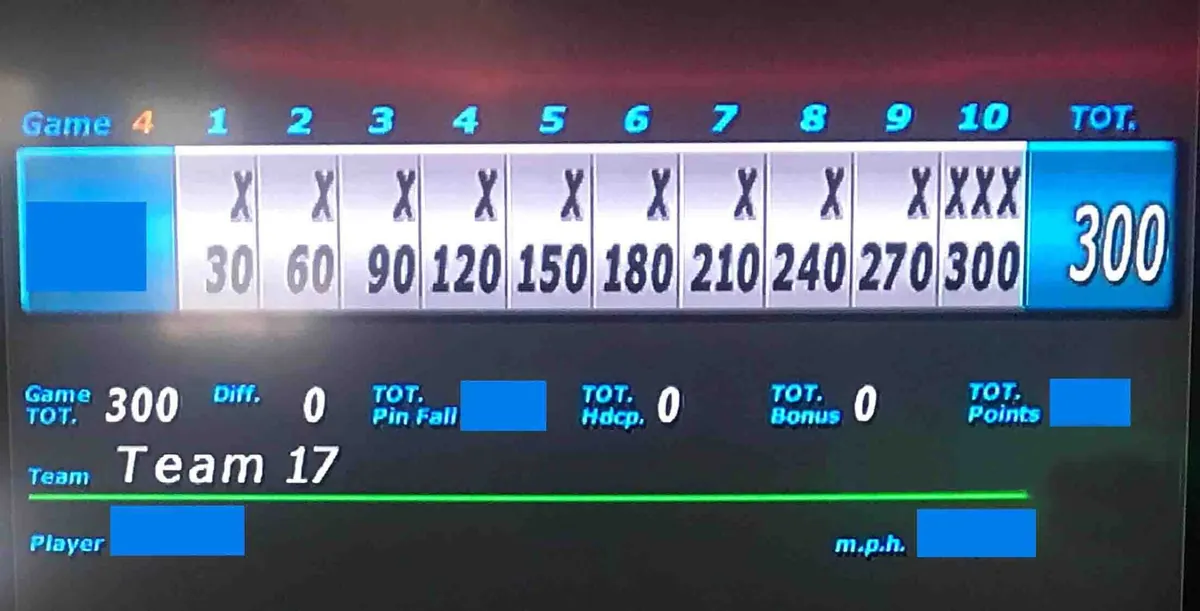
The 300 follows directly from the scoring system: a strike is worth 10 points plus the total number of pins knocked down on the next two deliveries. If those two deliveries are also strikes, the frame is worth 10 + 10 + 10 = 30 points. Ten frames at 30 points make 300.
That is why the 10th frame grants two extra deliveries after a strike: they are used to calculate the bonus for the 10th-frame strike. Here is the score sheet of a perfect game, with the running total frame by frame.
You can check this calculation, or any other game, with our bowling score calculator.
What are the odds of bowling a 300?
Your chances of bowling a 300 depend almost entirely on your strike percentage, and they drop off very quickly. If we assume, for simplicity, that every delivery has the same probability of being a strike, the probability of stringing 12 together is that probability multiplied by itself 12 times.
| Strike rate per delivery | Probability of a 300 game | Roughly |
|---|---|---|
| 30% (regular recreational bowler) | 0.00005% | 1 in 1.9 million |
| 50% | 0.024% | 1 in 4,096 |
| 60% (good league bowler) | 0.22% | 1 in 459 |
| 70% | 1.4% | 1 in 72 |
| 80% | 6.9% | 1 in 15 |
This calculation is theoretical: in reality, the pressure builds as the strikes pile up, and lane conditions change as the game goes on. It does, however, show one simple thing: for a casual bowler, a 300 is an extremely rare feat, whereas for an experienced bowler on a favourable lane it becomes an achievable goal. It is also why the number of certified 300 games has risen sharply since the 1990s, with the arrival of reactive resin balls and changes in lane oiling.
Perfect games that made history
Several 300 games have gone down in bowling history, either because they were the first or because they were bowled in front of the cameras.
- 1902 and 1908: Ernest Fosberg bowled a 300 in a league in Illinois in 1902, but it was A. C. Jellison, in St. Louis on 15 December 1908, who was the first to receive the American Bowling Congress's official award for a perfect game.
- 1 April 1967: Jack Biondolillo bowled the first nationally televised 300 in the United States, at the Firestone Tournament of Champions in Akron (Ohio).
- 1970: Japan's Ritsuko Nakayama became the first woman to bowl a 300 on television.
- 23 January 1988: Bob Benoit bowled the first 300 in the televised finals of a PBA tournament, at the Quaker State Open, winning a $100,000 bonus.
What is a 900 series?
A 900 series is a series of three consecutive games all finishing at 300, i.e. 36 strikes in a row. It is the rarest achievement in ten-pin bowling. The first reported 900, by Glenn Allison in 1982, was not certified, and neither were the ones that followed, mainly because the lane conditions did not comply with the rules.
The first certified 900 series was bowled by student Jeremy Sonnenfeld on 2 February 1997, at Sun Valley Lanes in Lincoln (Nebraska). According to USBC data, at the end of February 2026 there had been 43 certified 900 series, bowled by 42 different players: only Robert Mushtare has managed more than one.
The 299 and other “near-perfect” games
A score of 299 is the most frustrating in bowling: it means 11 strikes in a row followed by a final delivery of 9 pins. With 11 strikes and then just one pin on the last delivery, you drop to 291. A mistake costs more early in the game: a first frame of 9 then a spare, followed by 11 strikes, gives 290; a first frame of 9 with no spare, followed by 11 strikes, only 279.
Beyond the 300, federations record other honour scores, such as a series of 800 or more over three games, or “11 in a row” (11 consecutive strikes).
Does a 300 need special conditions to be official?
Yes: to be certified as an honour score, a 300 must be bowled in a competition recognised by a federation, whether a league or a tournament, on a lane and with balls that meet the standards. In the United States, the USBC checks lane oiling and equipment in particular before recording certain exceptional scores, which explains why the first 900 series were rejected. A 300 bowled in a game with friends is still a remarkable performance, but it will not appear in any official record book. In Morocco, where there is no federation yet, league scores are tracked by associations, such as the ASBM (Association Sportive du Bowling Marocain, the Moroccan Bowling Sports Association) for its Rabat league.
How to get closer to a 300
No bowler aims for a 300 in their very first game: you get closer by raising your strike rate and eliminating mistakes. The steps are always the same:
- Make your delivery consistent: a steady approach and a repeatable release; see our guide to basic bowling technique.
- Aim for the pocket: between the 1 and 3 pins for a right-hander, between the 1 and 2 for a left-hander, with enough entry angle. See how to bowl a strike.
- Use a suitable ball and learn to read the oil on the lane.
- Bowl regularly, ideally in a league. In Morocco, the ASBM runs a weekly league at the Megamall in Rabat and offers coaching from experienced bowlers.
Frequently asked questions
How many strikes do you need to bowl a 300?
You need 12 strikes in a row: one in each of the first 9 frames and three in the 10th frame. A single delivery without a strike means you cannot reach 300.
What is the highest possible score in bowling?
The highest possible score in a game of ten-pin bowling is 300 points. Over a three-game series, the maximum is therefore 900.
Who bowled the first certified 900 series?
Jeremy Sonnenfeld, on 2 February 1997 in Lincoln (Nebraska). The 900 series reported before his, including Glenn Allison's in 1982, were not certified.
Is it rare to bowl a 300?
For a recreational bowler, it is extremely rare: with a 30% strike rate, the theoretical probability is about 1 in 1.9 million. For a good league bowler, it is still a feat, but an achievable one.
What do you score with 11 strikes and 9 pins on the last delivery?
You get 299, the most frustrating score in bowling, since you are just one pin short of perfection.