Key points
- The pocket is between the 1 and 3 pins for a right-hander, and the 1 and 2 for a left-hander.
- A USBC study puts the ideal point of impact at board 17.5, about 2.5 boards from the centre on the pocket side.
- An entry angle close to 6 degrees maximises your chances of a strike; a perfectly straight ball can barely exceed 1.5 degrees.
- Aim at an arrow about 4.5 m away and adjust by moving your feet in the direction of the miss.
- In an ideal strike, the ball touches only 4 pins (1, 3, 5 and 9); the rest fall through a chain reaction.
What is the pocket in bowling?
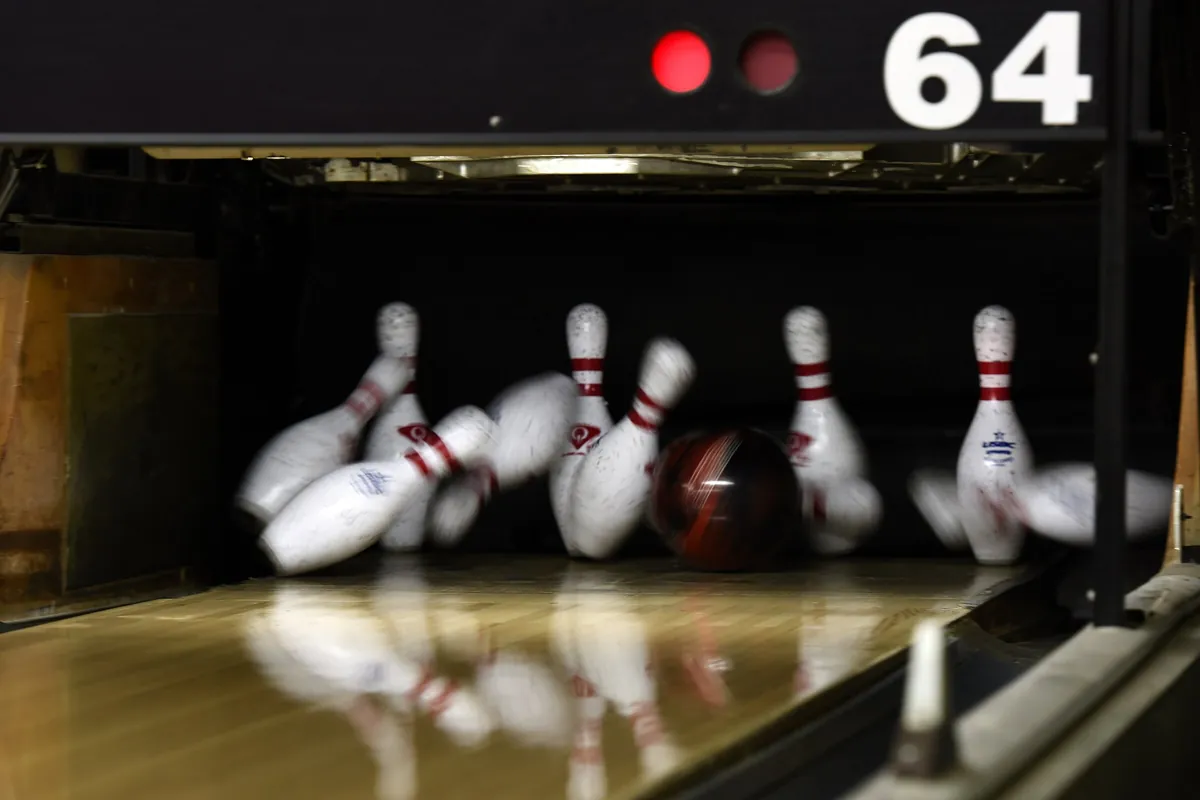
The pocket is the point of impact that gives you the best chance of a strike: between the 1-pin and the 3-pin for a right-hander, and between the 1 and the 2 for a left-hander. A ball that enters here only hits four pins directly, and the chain reaction takes care of the rest.
Here is how a “perfect” strike works for a right-hander:
- the ball hits the 1, which goes left and knocks down the 2, which knocks down the 4, which knocks down the 7;
- the ball hits the 3, which knocks down the 6, which knocks down the 10;
- the ball, deflected towards the centre, hits the 5, which knocks down the 8;
- the ball finishes its path on the 9.
A USBC (United States Bowling Congress) study on pin carry found that the centre of the ball should ideally be on board 17.5 at the moment of impact, counting from the right edge of the lane for a right-hander. The headpin sits on board 20 (the centre board), so the ideal pocket is just 2.5 boards from the centre, or about 6.8 cm. It is a narrow target, which is why consistency matters so much.
Why is the entry angle so important?
The entry angle is the angle between the ball’s path and the centre line of the lane at the moment it hits the pins. The wider it is, the less the ball is deflected by the pins and the more energy it keeps to reach the 5 and the 9. USBC research puts the optimal angle at around 6 degrees.
That is the whole difference between a straight ball and a hook ball. Even when thrown from the far corner of the lane, a perfectly straight ball cannot exceed an entry angle of about 1.5 degrees, for purely geometric reasons: the lane is 18.29 m long and barely 1.05 m wide. A ball that hooks in the last few metres can reach 4 to 6 degrees.
With a shallow angle, the ball is deflected to the right (for a right-hander) after hitting the 1 and the 3. It then misses the 5, or hits it too weakly: that is why straight-ball bowlers often leave the 5-pin or the 10-pin standing, even with a well-placed hit. You can bowl strikes with a straight ball, but your strike rate will be lower.
How do you aim to hit the pocket?
You aim at an arrow, not at the pins. The seven arrows set into the lane about 4.5 m (15 ft) from the foul line are 5 boards apart: the first arrow from the edge is on board 5, the second on board 10, the third on board 15 and the centre arrow on board 20. Left-handers count the boards from the left edge.
A practical method for a right-handed beginner:
- Straight ball: place your sliding foot (left) around boards 12 to 15 on the approach and aim at the second arrow (board 10). The line this creates runs slightly diagonally, from right to left, into the pocket.
- Hook ball: start further left on the approach and aim at the second arrow; the ball skids, keeps heading right, then hooks into the pocket in the last third of the lane.
- Keep your eyes on the arrow until the ball rolls over it. Looking up at the pins as you release the ball is one of the most common causes of error.
This intermediate targeting relies on a consistent technique; if your approach still varies a lot, start with basic bowling technique.
How do you adjust your line when you miss the pocket?
The simplest rule: keep the same arrow and move your feet in the direction of the miss. If the ball arrives too far left, move left; if it arrives too far right, move right. Start with a 2-board move.
| What you see (right-hander) | What is happening | Adjustment |
|---|---|---|
| The ball hits the 1 head-on | Hit too high (“nose” hit), risk of a split | Feet 1 to 2 boards left, same arrow |
| The ball crosses over between the 1 and the 2 (Brooklyn) | Too much hook or a line too far left | Feet 2 to 3 boards left |
| The ball mainly hits the 3 | Hit too light, the 1 falls badly | Feet 2 boards right |
| The ball fails to hook and slides off to the right | Lane oilier than expected or too much speed | Feet and target to the right, or slightly less speed |
For a left-hander, everything is reversed: the pocket is to the left of the headpin and the adjustments go the other way. The amount and distribution of lane oil have a big influence on these adjustments; the subject is covered in detail in lane oil patterns.
What do the pins left standing tell you?
The pins left after a pocket hit show how the ball entered. Reading them lets you correct your speed, angle or point of impact.
- The 10-pin alone (right-hander): often a slightly light hit or a lack of angle; the 6-pin slides in front of the 10 without touching it. It is the most frustrating pin in the game, even for professionals.
- The 5-pin alone: the ball lost too much energy or was deflected; it lacks angle or ball weight.
- A 2-4-5-8 cluster (the “bucket”): hit too light, the ball only clipped the side of the 1.
- A split such as the 4-6 or 7-10: often a hit too full on the 1, which scatters the pins to either side.
To convert these leaves, see our guide on how to pick up spares.
Do you need a hook to bowl strikes?
No, it is not essential, but it is more effective. A beginner who throws a straight ball consistently into the pocket will bowl strikes. To increase your strike percentage significantly, however, you need angle, and therefore revs. Rental balls, made of polyester, hook very little; a reactive resin ball drilled to fit your hand makes a hook much easier to achieve. The principles of rotation, axis and release are explained in how to hook a bowling ball, and choosing equipment in how to choose a bowling ball.
Weight matters too: on the same path, a heavier ball is deflected less by the pins. But a ball that is too heavy hurts your accuracy, which costs you far more strikes than it earns.
Which drills help you bowl more strikes?
- Arrow targeting: for a whole game, do not keep score; just note whether the ball rolled over your target arrow. Goal: 8 shots out of 10.
- Foot marker check: after each shot, check which board your sliding foot stopped on. A drift of more than 2 boards from your starting position means your approach is wandering.
- Consistent speed: if the centre displays ball speed, try to stay within a 1 km/h range.
- League bowling: nothing beats regular games on the same lane. The ASBM (Association Sportive du Bowling Marocain, the Moroccan Bowling Sports Association) runs a weekly league at the Megamall in Rabat and inter-city events such as the Intercity Strike Cup.
Find a lane to practise on in our directory of bowling centres in Morocco, then check how your strikes affect your score with the score calculator: a strike is worth 10 points plus your next two shots, and 12 strikes in a row make a perfect game of 300.
Frequently asked questions
Where should you aim to bowl a strike?
Aim at one of the arrows on the lane, about 4.5 m from the foul line, so that the ball reaches the pocket between the 1 and 3 pins (right-hander) or the 1 and 2 pins (left-hander). The second arrow, on board 10, is a good starting point.
Can you bowl a strike with a straight ball?
Yes, a straight ball placed well in the pocket can produce a strike. However, the entry angle of a straight ball remains small (1.5 degrees at most), which more often leaves the 5-pin or the 10-pin standing.
Where is the pocket for a left-hander?
For a left-hander, the pocket is between the 1-pin and the 2-pin. All the aiming and adjustment tips are then reversed compared with a right-hander.
Why is the 10-pin so often left standing?
For a right-hander, the 10-pin is often left standing when the hit is slightly light or the entry angle is too shallow: the 6-pin slides in front of the 10 without knocking it down.
How many pins does the ball touch in a strike?
In an ideal strike, the ball only directly touches four pins: the 1, 3, 5 and 9 for a right-hander. The other six fall through a chain reaction.