Key points
- One game = 10 frames; 2 deliveries per frame, up to 3 in the 10th after a strike or spare.
- The 10 pins form a triangle numbered from 1 (front) to 10; pins 7 to 10 are in the back row.
- Touching or crossing the foul line is a foul: the pins knocked down don't count.
- The lane measures 18.29 m from the foul line to the headpin; the ball weighs 16 lb (7.26 kg) at most.
- The reference rules are those of the USBC in the United States and the IBF internationally.
What is the aim of the game in bowling?
The aim of bowling is to knock down as many pins as possible by rolling a ball down a lane, to get the highest score after 10 frames. Scores range from 0 to 300, the maximum being 12 strikes in a row, known as a “perfect game”.
Ten-pin bowling, the most widespread form in the world and the only one played in bowling centres in Morocco, is governed by harmonised rules. In the United States they are set by the USBC (United States Bowling Congress); internationally, by the IBF (International Bowling Federation), which among other things organises the world championships. For casual bowling, centres apply these rules in a simplified form, and the computer calculates everything automatically.
How are the pins arranged?
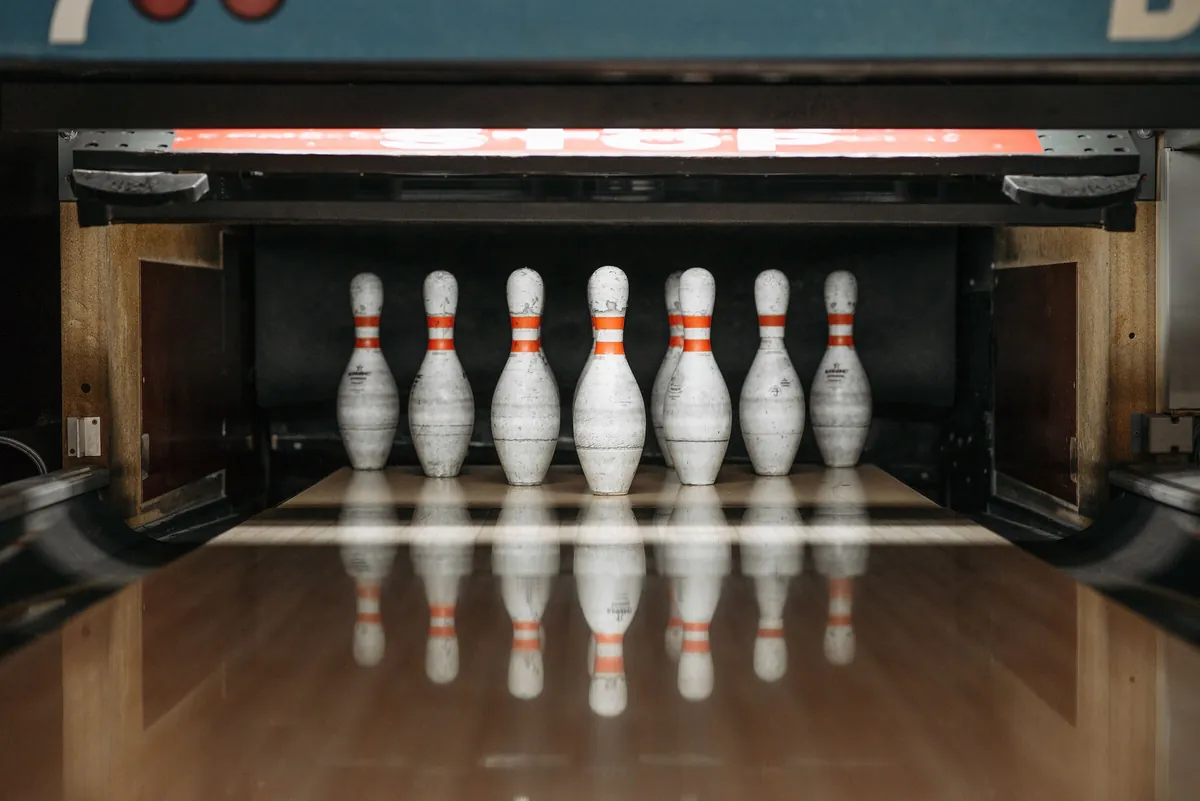
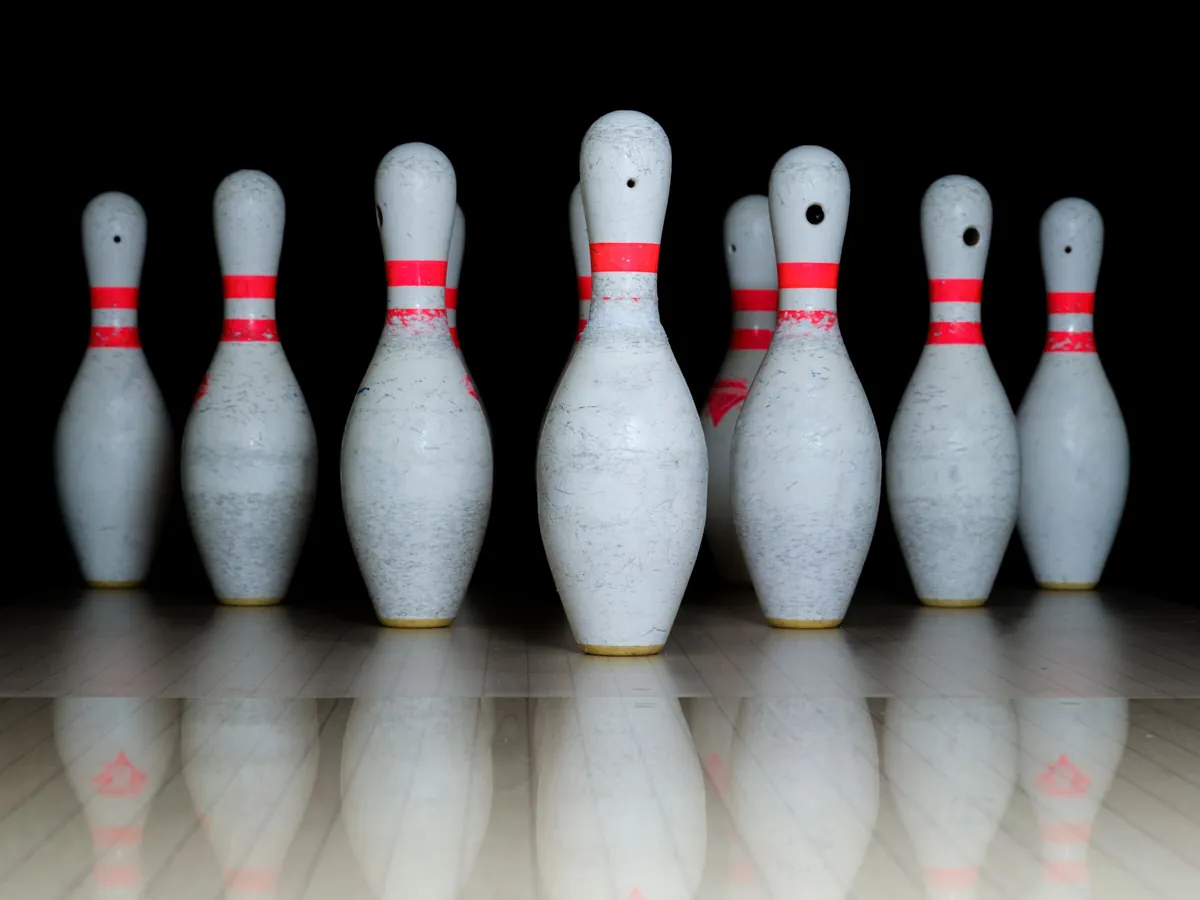
The 10 pins are set up in an equilateral triangle, with the point facing the bowler, in four rows of 1, 2, 3 and 4 pins. They are numbered from 1 to 10, front to back and left to right as seen from the approach.
Pin 1 is called the headpin. Pin 5, in the middle of the triangle and hidden from the bowler's view, is nicknamed the “kingpin”. Pins 7 and 10, in the two back corners, are the hardest to pick up as spares. Each pin is 38.1 cm (15 inches) tall and weighs between 1.53 and 1.64 kg (3 lb 6 oz to 3 lb 10 oz).
How does a game work?
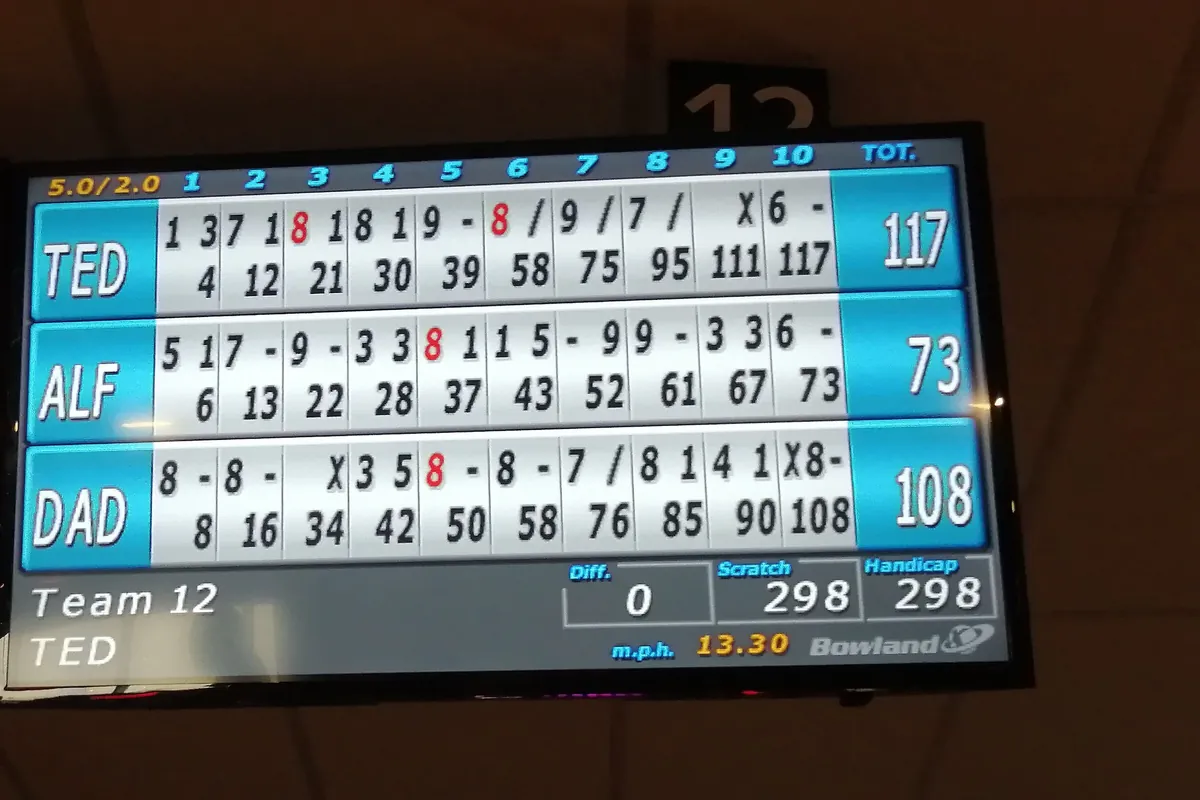
A game consists of 10 frames, bowled in turn; in each frame, the bowler has two deliveries to knock down all 10 pins. If all the pins fall on the first delivery, it's a strike and the frame ends. If they fall in two deliveries, it's a spare. Otherwise, the frame is called “open”.
Between the two deliveries of a frame, the machine (the pinsetter) clears away the fallen pins and puts the ones still standing back in exactly the same position. Pins knocked down on the first delivery are not put back into play.
In competition, bowlers on the same pair of lanes switch from one lane to the other every frame (the so-called “American” format), so that everyone bowls equally on both surfaces. For casual bowling, you stay on a single lane.
What happens in the 10th frame?
In the 10th frame, a strike earns two extra deliveries and a spare earns one extra delivery, so you can roll up to three balls. These bonus deliveries are used to complete the scoring of the strike or spare in the last frame.
| Result in the 10th frame | Deliveries bowled | Example notation |
|---|---|---|
| Open frame | 2 | 7 2 |
| Spare | 3 | 8 / 6 |
| Strike | 3 | X 8 1 |
| Three strikes | 3 | X X X |
Exactly how the bonuses are calculated is explained, with a full game worked through, in our guide on how to keep score in bowling.
What is a foul in bowling?
A foul occurs when any part of the bowler's body touches or goes past the foul line, or touches any part of the lane or equipment beyond it, during or after the delivery. The foul is signalled by an electronic detector or by an official, and marked “F” on the score sheet.
- The delivery counts, but the pins knocked down don't count (0 points).
- If the foul happens on the first delivery, all the pins are reset and the bowler takes the second delivery at all 10 pins: only a spare is possible, not a strike.
- If the foul happens on the second delivery, only the pins from the first delivery count.
In casual play, the foul detector is often switched off, but the line is still a safety limit: beyond it, the lane is oiled and very slippery.
Which pins count and which don't?
All pins knocked down or pushed off the pin deck by the ball or by other pins count, including those that bounce off the side walls. A pin that is merely moved but stays standing doesn't count.
The following, however, do not count:
- pins knocked down by a ball that left the lane (for example, went into the gutter) before reaching the pins;
- pins hit by the ball rebounding off the rear cushion;
- pins knocked down by the machine or by staff;
- pins that fall on a foul.
A pin that falls and then stands back up is considered standing. When a delivery is disrupted (a pin missing at the start, a bowler interfered with by someone else, the ball hitting an obstacle), the official can declare a dead ball: the delivery is cancelled and bowled again.
What is a split?
A split is a set of pins left standing after the first delivery, when the headpin has been knocked down and at least one pin has fallen between two remaining pins or just in front of them. The 7-10, 4-6 and 3-10 are classic splits; the 7-10 is the most dreaded, because the two pins are at opposite ends of the triangle.
On score sheets a split is marked with a circle around the number, or with a colour on screens. It doesn't change the scoring, but it makes the spare much harder. Leaves where the headpin is still standing, such as the 1-2-10, are technically not splits; they are called “washouts”. Techniques for converting them are in our guide on how to pick up spares, and all the terminology is gathered in the bowling glossary.
What are the official lane and ball dimensions?
The lane measures 18.29 m (60 feet) from the foul line to the centre of the headpin, and is 41.5 inches (about 1.05 m) wide, divided into 39 boards. It is preceded by an approach at least 4.57 m (15 feet) long.
| Element | Official standard |
|---|---|
| Lane length (foul line to pin 1) | 18.29 m (60 feet) |
| Lane width | 41.5 inches (≈ 1.05 m), 39 boards |
| Approach | at least 4.57 m (15 feet) |
| Pin height | 38.1 cm (15 inches) |
| Pin weight | 1.53 to 1.64 kg |
| Maximum ball weight | 16 pounds (7.26 kg) |
| Maximum ball diameter | 8.595 inches (21.83 cm) |
There is no minimum ball weight for casual bowling: everyone chooses according to their strength. For details on boards, arrows and markers, see our guide to bowling lane and pin dimensions. And if you want to bowl under these rules in competition in Morocco, the ASBM (Association Sportive du Bowling Marocain, the Moroccan Bowling Sports Association) organises leagues and tournaments, including the Intercity Strike Cup.
Frequently asked questions
How many frames are there in a game of bowling?
A game of bowling has 10 frames. Each frame has a maximum of two deliveries, except the 10th, which can have three after a strike or spare.
What happens if you step on the foul line in bowling?
It's a foul: the delivery counts but the pins knocked down score 0. After a foul on the first delivery, all 10 pins are reset for the second.
How are bowling pins numbered?
The pins are numbered from 1 to 10, front to back and left to right as seen by the bowler. Pin 1 is at the front, pins 2 and 3 behind it, then 4, 5 and 6, and finally 7, 8, 9 and 10 at the back.
What is the hardest split in bowling?
The 7-10 split is considered the hardest: the two remaining pins are in the two back corners of the triangle, and you have to knock one into the other.
Does a pin that falls into the gutter count?
Yes, a pin knocked down by the ball or by another pin counts, even if it ends up in the gutter. However, a ball that goes into the gutter before reaching the pins scores nothing.
What is the maximum weight of a bowling ball?
The maximum weight allowed is 16 pounds, or 7.26 kg. There is no minimum weight: house balls usually start at 6 pounds.