Key points
- A game has 10 frames; in each frame you get 2 deliveries to knock down all 10 pins.
- Hold the ball with your middle and ring fingers inserted up to the second knuckle and your thumb all the way in.
- A 4-step approach is all you need to start: the ball moves forward on the first step and is released on the last.
- Aim at the arrows about 4 to 5 m past the foul line, not at the pins more than 18 m away.
- The highest possible score is 300, which means 12 strikes in a row.
How does a game of bowling work?
A game of bowling is played over 10 frames, and each player gets two deliveries per frame to knock down the 10 pins set up in a triangle at the end of the lane. Players take turns, frame by frame, and the centre's computer automatically displays the scores on the screen above the lane.
Three things can happen in each frame:
- Strike: all 10 pins fall on the first delivery. The frame is over and you score 10 points plus the total of your next two deliveries.
- Spare: all 10 pins fall in two deliveries. You score 10 points plus your next delivery.
- Open frame: some pins are still standing after two deliveries. You simply score the number of pins knocked down.
The 10th frame is special: a strike earns you two extra deliveries, a spare one extra delivery. That is what makes the perfect score of 300 possible, i.e. 12 strikes in a row. The maths is explained in detail in our guide on how to keep score in bowling.
At a leisure centre, allow an average of 10 to 15 minutes per player per game. A game for four people therefore usually takes between 40 minutes and an hour, depending on the group's pace.
How to choose a ball as a beginner
The right ball is the heaviest one you can control without straining, with holes that fit your fingers. Centres provide “house balls”, generally weighing from 6 to 16 lb (about 2.7 to 7.3 kg), with the weight marked on the ball.
- Weight: a common rule of thumb is around 10% of your body weight, without going beyond what you can hold comfortably. If your arm shakes or your shoulder starts to ache after a few shots, go down one or two pounds.
- Thumb: it should slide in and out of the hole without rubbing or wobbling. A thumb hole that is too tight holds on to the ball at release; one that is too loose forces you to squeeze.
- Span: with your thumb fully inserted, the second knuckle of your middle and ring fingers should reach the edge of the finger holes.
Stick with the same ball for the whole game: switching weights every frame stops you from building a consistent motion. Note its number or colour from your very first shot.
To find out more about equipment, see our guide to bowling for the first time, which also covers shoes and what to wear.
How to hold a bowling ball
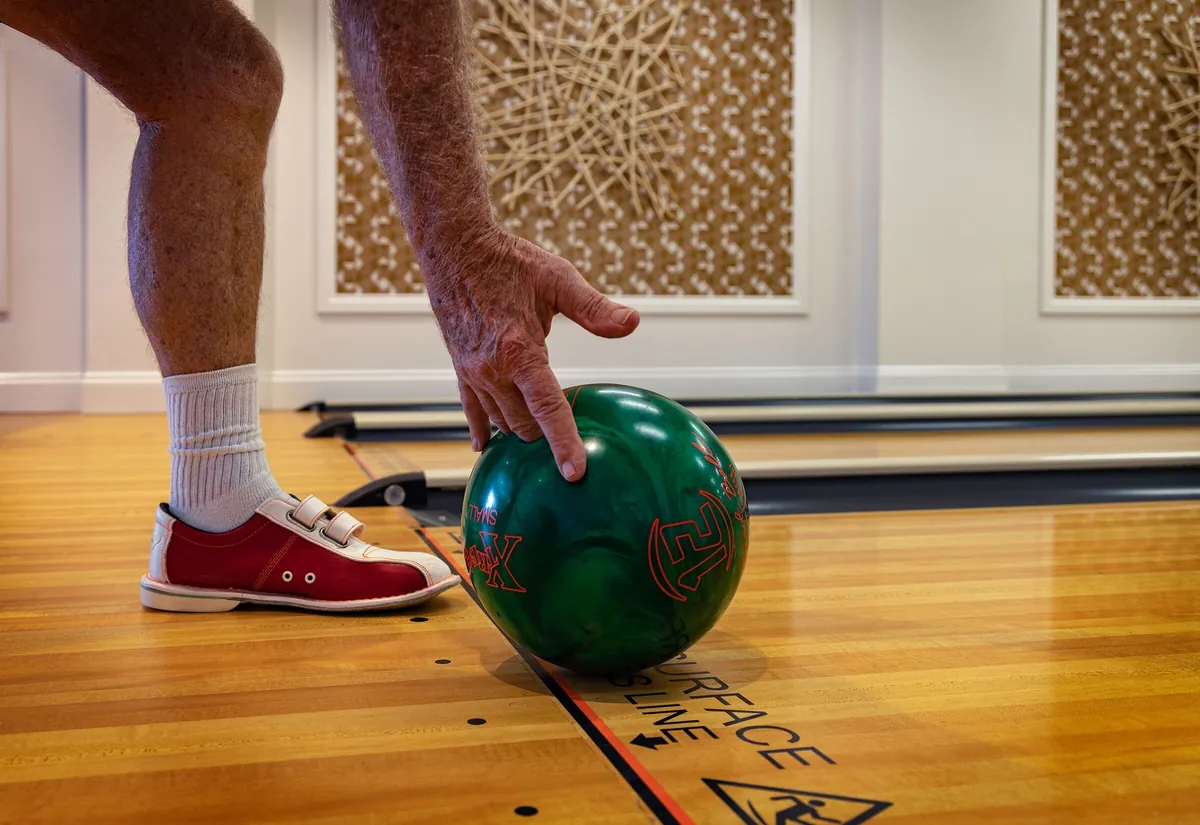
The classic grip, known as the “conventional” grip, means inserting your middle and ring fingers up to the second knuckle, then your whole thumb. Your index and little fingers rest flat on the surface of the ball to steady it.
Before you get into position, support the ball with your other hand: it carries the weight while you set up, not the fingers of your bowling hand. Hold the ball at waist or chest height, elbow close to your body, wrist firm and in line with your forearm. A wrist that “breaks” backwards costs you all your accuracy.
How to do the 4-step approach
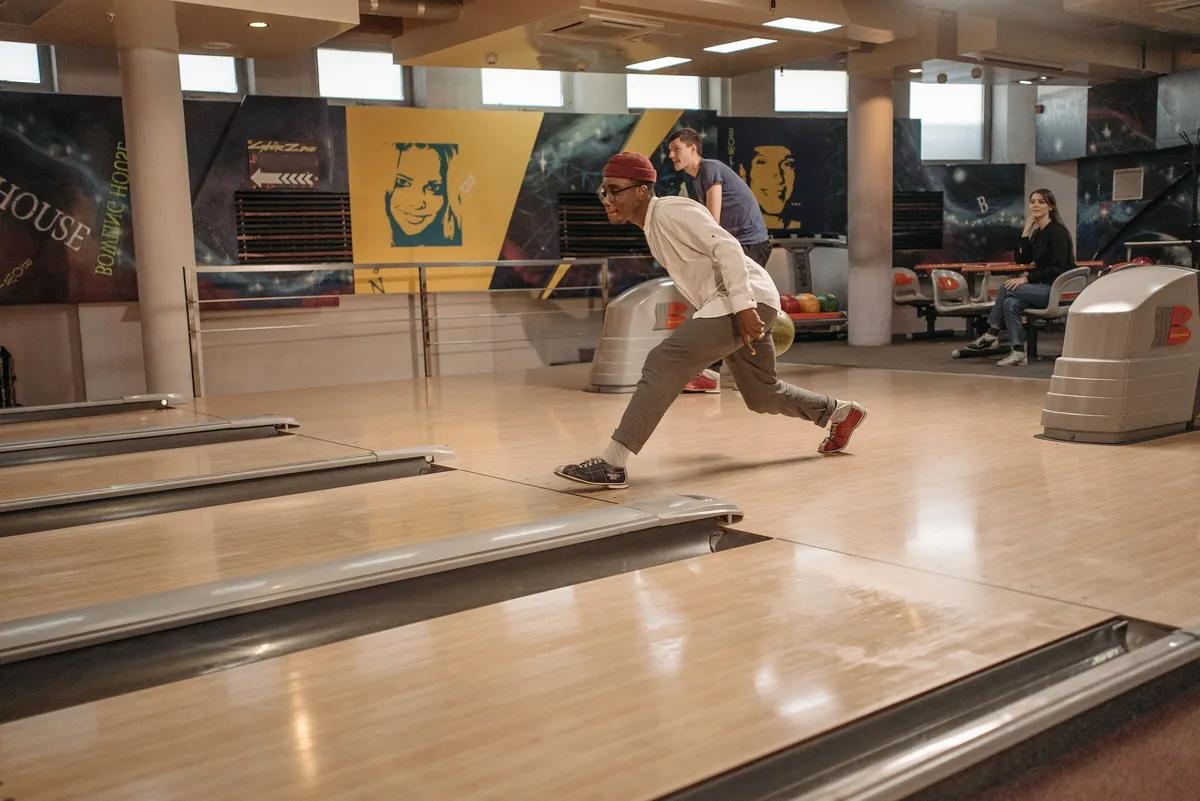
The approach is the walk of 4 or 5 steps leading up to the release; with 4 steps, the ball starts moving on the first step and leaves your hand on the fourth. To find your starting point, stand on the foul line with your back to the pins, take 4½ normal steps, then turn around: you are at the right distance.
- First step (right foot for a right-hander): push the ball forward, arm extended, as if handing it to someone.
- Second step: let the ball swing down under its own weight, alongside your leg.
- Third step: the ball reaches the top of the backswing, no higher than your shoulder.
- Fourth step: slide on your left foot, knee bent, as the ball swings down and passes close to your ankle.
Left-handers simply swap feet. What matters most is consistency: identical steps from one shot to the next are better than a fast run-up. The swing should stay a pendulum motion, arm relaxed, without “throwing” the ball with your shoulder.
Never cross the foul line: it is a foul that cancels the pins knocked down, and the lane beyond it is oiled, so very slippery.
How to release the ball properly
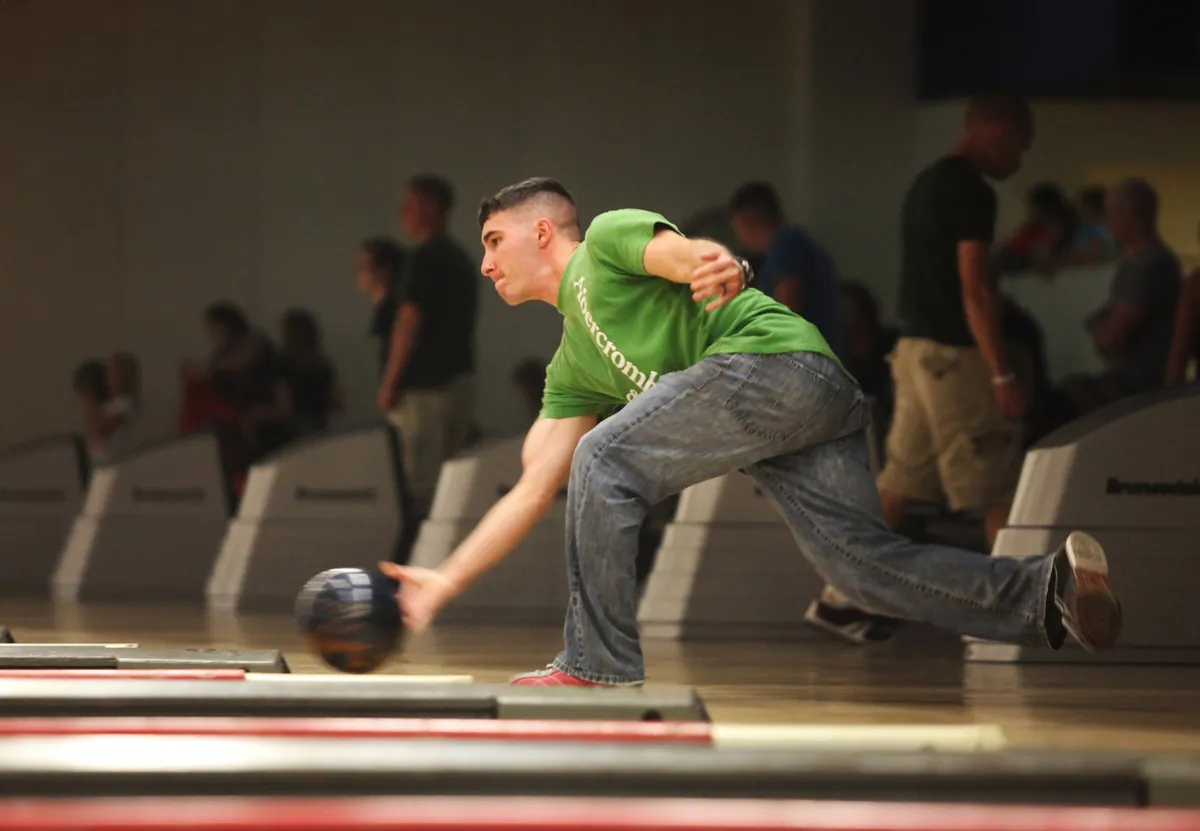
A good release happens close to the lane surface, just past the foul line: the ball should roll, not bounce. Your thumb comes out first, then your fingers follow the ball forward and slightly upward.
For a straight shot, keep your hand behind the ball, palm facing the pins, as if for a handshake. Finish the motion with your arm extended towards your target and your hand rising to shoulder height: this is the “finish”. Hold your balance on your front leg for a second; if you have to step sideways to avoid falling, your approach was too fast.
With experience, you learn to put hook on the ball by rotating your hand at release, which curves its path towards the pins. You don't need it to get started; our guide on how to hook a bowling ball explains the technique when you are ready.
Where to aim on a bowling lane
You should aim at the arrows marked on the lane, about 4 to 5 m past the foul line, not at the pins standing 18.29 m away. A nearby target is much easier to hit accurately, a bit like a golfer picking a spot just in front of the ball.
The lane has 39 boards and 7 arrows, spaced 5 boards apart. For a right-hander, boards are counted from the right: the first arrow is on board 5, the second on board 10 and the centre arrow on board 20.
| Your level | Where to stand | Arrow to aim at |
|---|---|---|
| Straight ball, beginner | In the centre of the approach | Centre arrow (board 20) |
| Straight ball at an angle, right-hander | Slightly right of centre | 2nd arrow from the right |
| Hook ball, right-hander | Slightly left of centre | 2nd arrow from the right |
The ideal target for a strike is the pocket: the gap between the 1-pin and the 3-pin for a right-hander, between the 1 and the 2 for a left-hander. If your ball keeps passing to the left of the pocket, move your feet 2 or 3 boards to the left while keeping the same arrow; if it passes to the right, move to the right. Our guide on how to bowl a strike goes into this rule in more depth.
Mistakes to avoid in your first games
Most beginners miss pins for the same few reasons, all easy to fix:
- Looking at the pins instead of the arrows: keep your eyes on the target until the ball rolls over it.
- Throwing too hard: speed does not make up for a bad angle. A steady, accurate shot knocks down more pins.
- Lofting the ball and letting it drop onto the lane: it is noisy, damages the lane and costs you control.
- Turning your shoulders during the swing: your shoulders should stay square to the target, otherwise the ball goes off to the side.
- Neglecting spares: a player who converts their spares quickly gets past 120–130 points, even without many strikes.
For the pins left standing, follow a simple rule: aim for the pin closest to you, throwing diagonally from the opposite side of the approach. For a single 10-pin on the right, a right-hander stands on the left and throws towards the right.
Where to bowl and how to improve in Morocco
Morocco has several bowling centres, most of them located in shopping malls or leisure complexes, in Casablanca, Rabat, Marrakech and Tangier. Find addresses, opening hours and practical information on our page listing bowling centres in Morocco, or go straight to the bowling in Casablanca and bowling in Rabat pages.
To improve beyond nights out with friends, nothing beats playing regularly in a league. The ASBM (Association Sportive du Bowling Marocain, the Moroccan Bowling Sports Association), founded in 2007 in Rabat, runs a weekly league at the Megamall in Rabat and welcomes keen beginners and experienced bowlers alike. Before you get started, a quick look at our guide to bowling etiquette will help you pick up the right habits on the lanes.
Frequently asked questions
How many deliveries do you get per turn in bowling?
Each player gets two deliveries per frame to knock down the 10 pins. If you get a strike on the first delivery, the frame ends. In the 10th frame, a strike or a spare earns one or two bonus deliveries, for a maximum of three deliveries.
What ball weight should a beginner choose?
Choose the heaviest ball you can control without straining, often around 10% of your body weight. Most adult beginners bowl with a ball between 10 and 14 lb (4.5 to 6.4 kg).
Where should you look when you bowl?
Look at the arrows marked on the lane, about 4 to 5 m past the foul line, not at the pins. A nearby target lets you bowl much more accurately.
How long does a game of bowling take?
A game takes about 10 to 15 minutes per player. For a group of four people, allow 40 minutes to an hour per game.
What is the highest possible score in bowling?
The highest possible score is 300 points. You need 12 strikes in a row: one per frame from the 1st to the 9th, then three in the 10th frame.