Key points
- A hook gives you an entry angle that a straight ball cannot reach (about 1.5° at most, versus 4 to 6° with a hook).
- The ball path breaks down into three phases: skid, hook, roll.
- Rotation comes from the fingers, which exit after the thumb and lift up the side of the ball — never from twisting the wrist.
- A polyester house ball hooks very little; a reactive ball drilled for your hand multiplies the hook.
- The two-handed style, popularised in the late 2000s by Jason Belmonte, is allowed in competition.
What is a hook ball?
A hook ball, or simply a hook, is a delivery where the ball spins on an axis tilted relative to its direction of travel. While it crosses the oiled part of the lane, this rotation has almost no grip: the ball skids. When it reaches the dry area, friction turns the rotation into a change of direction, and the ball curves towards the pins.
The path of a hook ball has three phases:
- The skid: over the first few metres, the ball slides on the oil in an almost straight line.
- The hook: at the breakpoint, friction takes over and the ball changes direction.
- The roll: the ball has used up all its side rotation and rolls forward; ideally, this phase begins just before the pins.
For a right-hander, the ball heads out to the right and then comes back to the left; for a left-hander, it is the other way round. It is not about strength: the best bowlers don't throw faster than anyone else, they put more revs on the ball.
Why does a hook ball get more strikes?
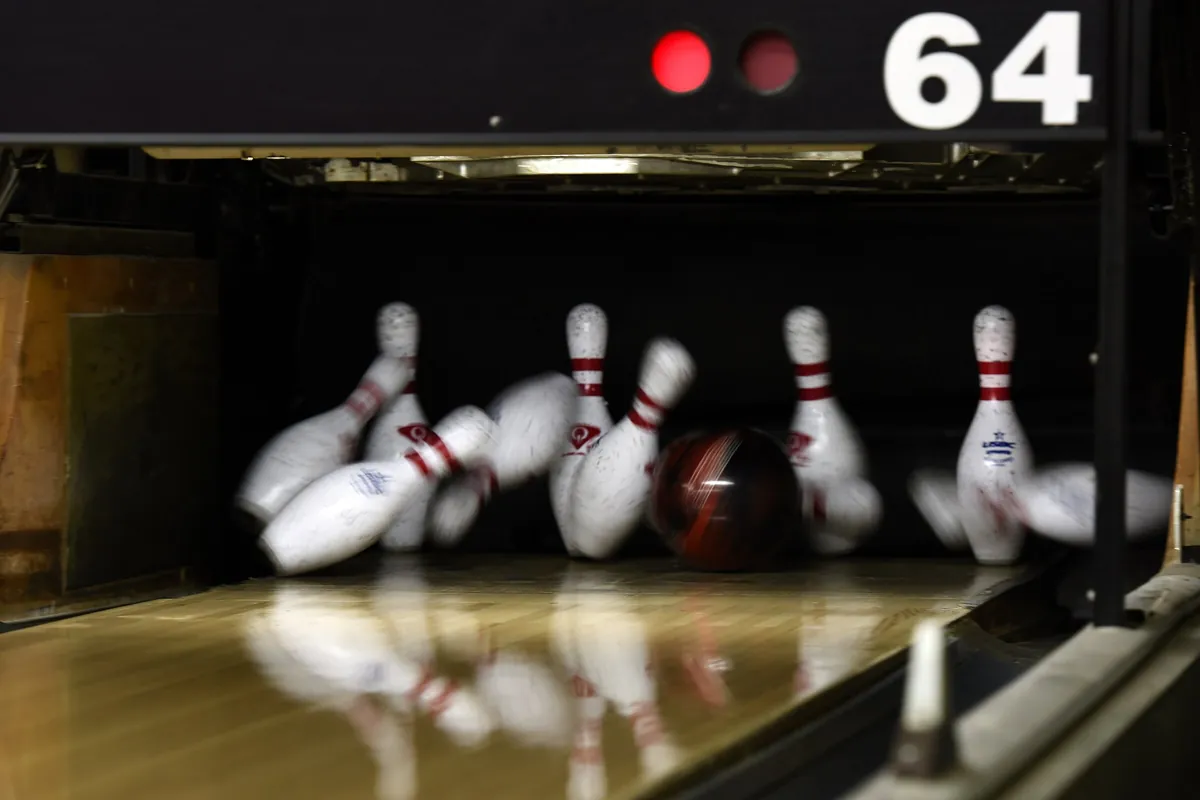
A hook lets the ball enter the pocket at a much wider angle. A straight ball, even thrown from the edge of the lane, enters the pins at an angle of about 1.5 degrees at most. A hook ball can reach 4 to 6 degrees, the range that USBC studies associate with the highest strike rate.
With more angle, the ball is deflected less by the 1-pin and the 3-pin, holds its line through to the 5 and the 9, and leaves the 10 or the 5 standing less often. How the pocket works is explained in detail in how to bowl a strike.
The flip side: a ball that hooks is more sensitive to changes in the oil and to errors in speed. That is why it is best to master a consistent straight ball before working on your hook.
How should you position your hand to hook the ball?
The basic position is the handshake: for a right-hander, the thumb points to 10 or 11 o'clock on an imaginary clock face, and the fingers (middle and ring) are under the ball, around 4 or 5 o'clock. The palm faces left rather than towards the pins.
The movement goes like this:
- Normal swing, firm wrist, hand already in the handshake position.
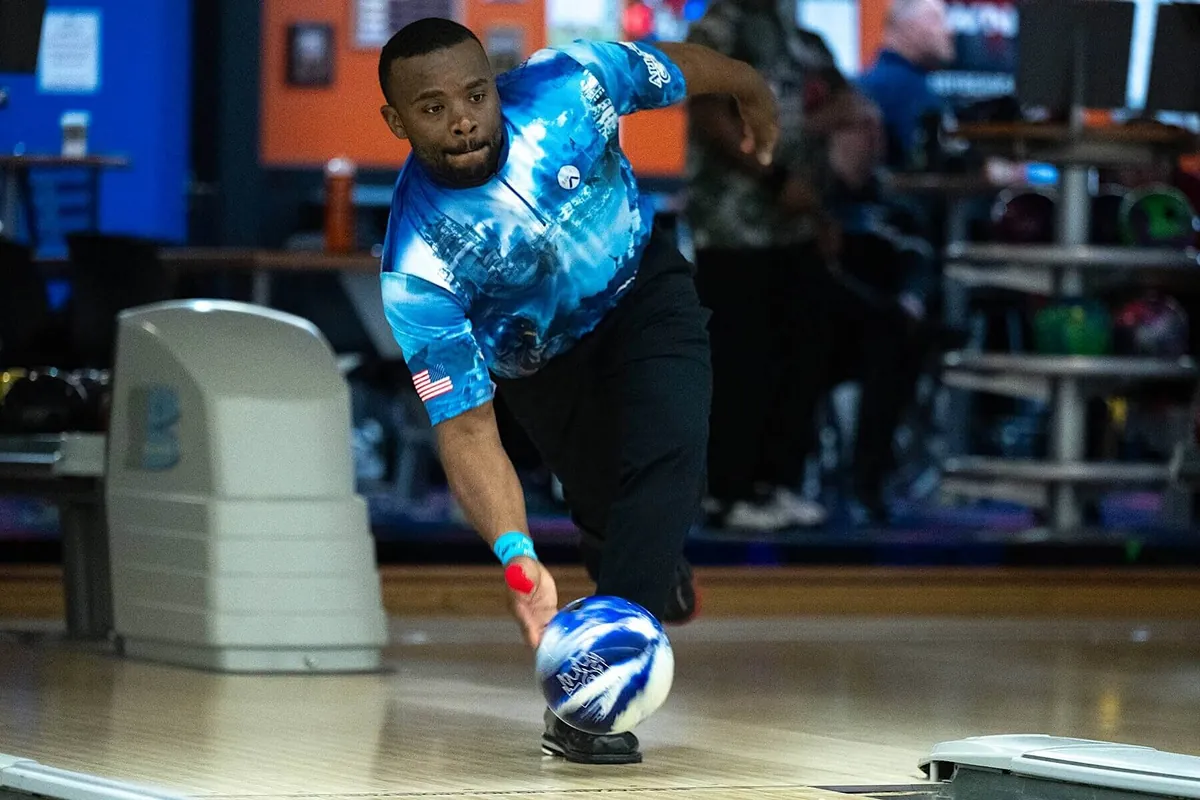
- At the bottom of the swing, in front of the ankle of your sliding foot, the thumb comes out first.
- The fingers stay in a split second longer and lift up the side of the ball, as if you were pulling up the handle of a suitcase or shaking someone's hand.
- The arm finishes high, towards the target, with the hand at shoulder height or above.
The thumb must come out cleanly. If it sticks, the fingers no longer have time to do their work and the ball leaves with no rotation or in the wrong direction; this is often a drilling problem, not a technique problem.
Avoid twisting your wrist or forearm excessively at release (the “turning a key in a lock” motion). It produces a ball that spins on the spot like a top without rolling forward, and it puts a lot of strain on the wrist and elbow.
Axis rotation, axis tilt and rev rate: what do they mean?
Three parameters describe how a ball spins, and therefore the shape of its hook.
| Parameter | Definition | Effect on the ball path |
|---|---|---|
| Axis rotation | Angle between the axis of rotation and the ball's direction, seen from above. 0° = pure forward roll, 90° = spinning top | The larger the angle, the longer the ball skids, then the later and harder it hooks |
| Axis tilt | Angle of the axis relative to the floor, seen from the front | The greater the tilt, the further the ball skids before it hooks |
| Rev rate | Number of revolutions per minute put on the ball | The higher it is, the greater the potential hook |
Bowlers are often classified by their rev rate. The commonly quoted ranges are as follows, but the boundaries vary from coach to coach:
- Stroker: moderate rotation (below roughly 300 rpm), a smooth and accurate game, a gentle ball path.
- Tweener: an in-between profile (roughly 300 to 400 rpm), the most common among good league bowlers.
- Cranker: lots of rotation (above roughly 400 rpm), a powerful hook, often with a more bent arm at release.
No style is better than another: what matters is that ball speed and revs are “matched”, so that the ball starts to roll just before the pins.
Do you need a special ball to hook?
You can make a house ball hook, but it is difficult. The centre's balls are made of polyester, a smooth material that grips the lane very little, and their holes are drilled in a standard way, with the fingers inserted up to the second knuckle (conventional grip). This grip limits the time during which the fingers can spin the ball.
Two things make all the difference:
- A reactive coverstock (reactive resin or particle): it grips the lane much more in the dry area and amplifies the hook.
- A fingertip drilling: the fingers only go in up to the first knuckle, which increases the span between thumb and fingers and lets you generate far more revs.
Materials, cores and typical prices are compared in our guide on how to choose a bowling ball. Also keep a polyester ball for single-pin spares, as explained in how to pick up spares.
One-handed or two-handed?
The two-handed style consists of keeping the non-bowling hand on the ball throughout the swing, without putting the thumb in its hole. It generates a very high rev rate. It was popularised in the late 2000s by Australian Jason Belmonte, who has become one of the most decorated players in PBA Tour history, and it is now used by many professionals.
That does not make it easier: it requires good back mobility and a very low, bent posture, and it makes controlling your line more demanding. For a bowler just starting to hook the ball, the one-handed style remains the simplest route, because it builds on the swing learned for the straight ball.
How do you learn to hook step by step?
- On the floor, away from the lane: roll the ball a few metres in the handshake position, concentrating on the thumb coming out first, then the fingers. Watch the rotation.
- On the lane, without worrying about your score: bowl at moderate speed aiming at the second arrow and note where the ball starts to turn.
- Move left (for a right-hander) as your hook grows, so the ball has room to come back to the pocket.
- Adjust your speed: if the ball hooks too early, throw a little faster; if it doesn't hook, a little slower, or move towards the drier area.
- Film yourself from the front to check that your hand finishes high and your wrist does not break.
How the ball reacts depends a great deal on the oil on the lane: the same release will make a big hook on a dry lane and almost nothing on a freshly oiled one. To understand these differences, read about lane oil patterns. And to benefit from the advice of experienced bowlers, get in touch with the ASBM (Association Sportive du Bowling Marocain, the Moroccan Bowling Sports Association), whose weekly league at the Megamall in Rabat welcomes bowlers of all levels.
Frequently asked questions
How do you make a bowling ball spin?
Put your hand in the handshake position, with the thumb at 10 or 11 o'clock for a right-hander. At release, let your thumb come out first, then lift your fingers up the side of the ball and finish with your arm high.
Can you hook a house ball?
Yes, but the hook will be limited: house balls are made of polyester, a material that grips the lane very little, and their standard drilling reduces rotation. A reactive ball with a fingertip drilling hooks much more.
Why won't my ball hook?
The most common causes are a polyester ball, too much speed, a heavily oiled lane or a release where the hand stays behind the ball. Try slowing down slightly and moving towards a drier part of the lane.
Is two-handed bowling allowed?
Yes, two-handed bowling is allowed both for fun and in competition. It was popularised in the late 2000s by Jason Belmonte.
When should you learn to hook the ball?
Once your straight ball is consistent, meaning the ball almost always rolls over the arrow you are aiming at. Working on a hook too early makes your line unpredictable.
Sources and references