Key points
- Length: 18.29 m (60 ft) from the foul line to the centre of the headpin (1-pin).
- Width: 41.5 in (≈ 1.05 m), or 39 boards of about 2.7 cm each.
- Approach: at least 4.57 m (15 ft), with rows of markers at 3.66 m and 4.57 m from the foul line.
- Targeting arrows: seven arrows about 4.5 m from the foul line, every 5 boards.
- Pin: 38.1 cm tall, 1.53 to 1.64 kg, made of maple with a plastic coating; 30.5 cm between neighbouring pins.
What are the official dimensions of a bowling lane?
A regulation bowling lane measures 18.29 m (60 ft) from the foul line to the centre of the headpin (1-pin) spot, and about 1.05 m (41.5 in) wide. These dimensions are set by the governing bodies, notably the USBC in the United States and the International Bowling Federation (IBF) worldwide, and are identical in every certified centre, from Morocco to Japan.
| Element | Metric | Original (imperial) |
|---|---|---|
| Foul line → centre of the headpin (1-pin) | 18.29 m | 60 ft |
| Foul line → pit (end of the lane) | ≈ 19.16 m | 62 ft 10 3/16 in |
| Headpin (1-pin) → pit (pin deck) | ≈ 0.87 m | 2 ft 10 3/16 in |
| Lane width | ≈ 1.05 m | 41.5 in |
| Number of boards | 39 | ≈ 1.06 in each |
| Approach (minimum) | 4.57 m | 15 ft |
| Targeting arrows | ≈ 3.7 to 4.9 m | 12 to 16 ft |
| Distance between neighbouring pins | 30.5 cm | 12 in |
On each side, a gutter (or channel) about 23.5 cm wide catches balls that leave the lane. Beyond the pins lie the pit, where balls and pins fall, and the back curtain that absorbs the impact.
What does a lane look like from above?
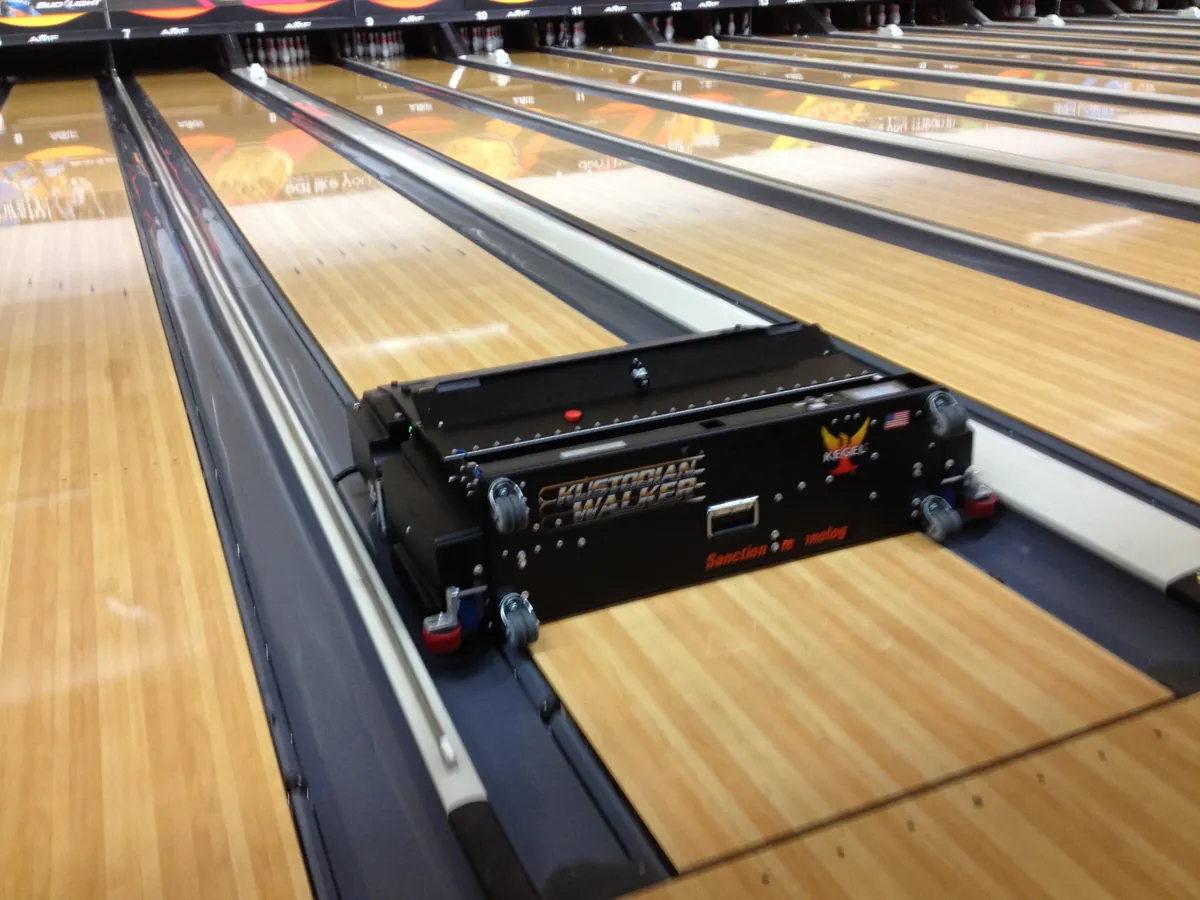
Seen from above, a lane is divided into three zones: the approach, where the bowler walks and slides; the lane itself, where the ball rolls; and the pin deck, the area where the pins stand.
What are the boards, arrows and dots for?
The boards, arrows and dots are targeting aids: they let the bowler choose a precise line and repeat it. On a wooden lane, the 39 boards are real strips of wood joined together; on a synthetic lane, they are printed into the surface. Either way, they are counted from 1 to 39 starting from the edge on the side of your bowling hand: from the right for a right-hander, from the left for a left-hander. Board 20 is the centre board, in line with the headpin (1-pin).
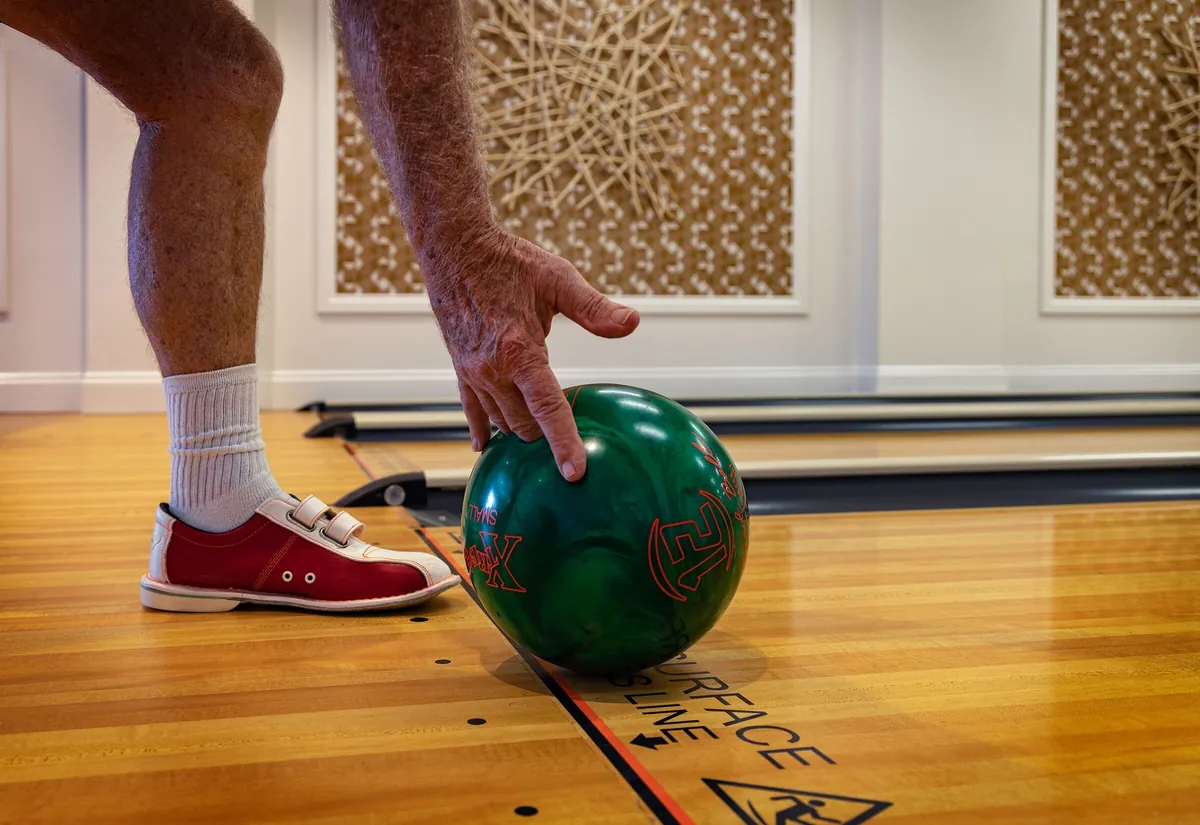
- Approach markers: two rows of dots on the approach, at 3.66 m (12 ft) and 4.57 m (15 ft) from the foul line, and often a row just before the line. They are used to position your feet at the start and to check where you slide.
- Targeting dots: a row of small dots on the lane, around 2.1 m (7 ft) from the foul line. Some bowlers use them as an intermediate target.
- Arrows: seven arrows set out in a V, between about 3.7 and 4.9 m from the foul line, on boards 5, 10, 15, 20, 25, 30 and 35. They are the most widely used aiming target.
- Downlane markers: some lanes have markings further down (between about 10 and 13 m), useful for spotting the breakpoint of a hook ball.
How to aim using the arrows is explained in how to bowl a strike, and how to use the boards for spares in how to pick up spares.
What are lanes made of?
Traditional lanes are made of wood: very hard maple for the approach, the first few metres of the lane and the pin deck, which take the impacts, and softer pine for the middle section. The wood was varnished and, later, coated with more durable finishes.
Today, most recent centres are fitted with synthetic lanes: high-pressure laminate or composite panels laid on a base and printed with a board pattern. They need less maintenance and keep a more stable surface over time. Whatever the material, the lane is coated with oil along part of its length, which directly affects the ball’s path: see lane oil patterns.
What are the specifications of a bowling pin?
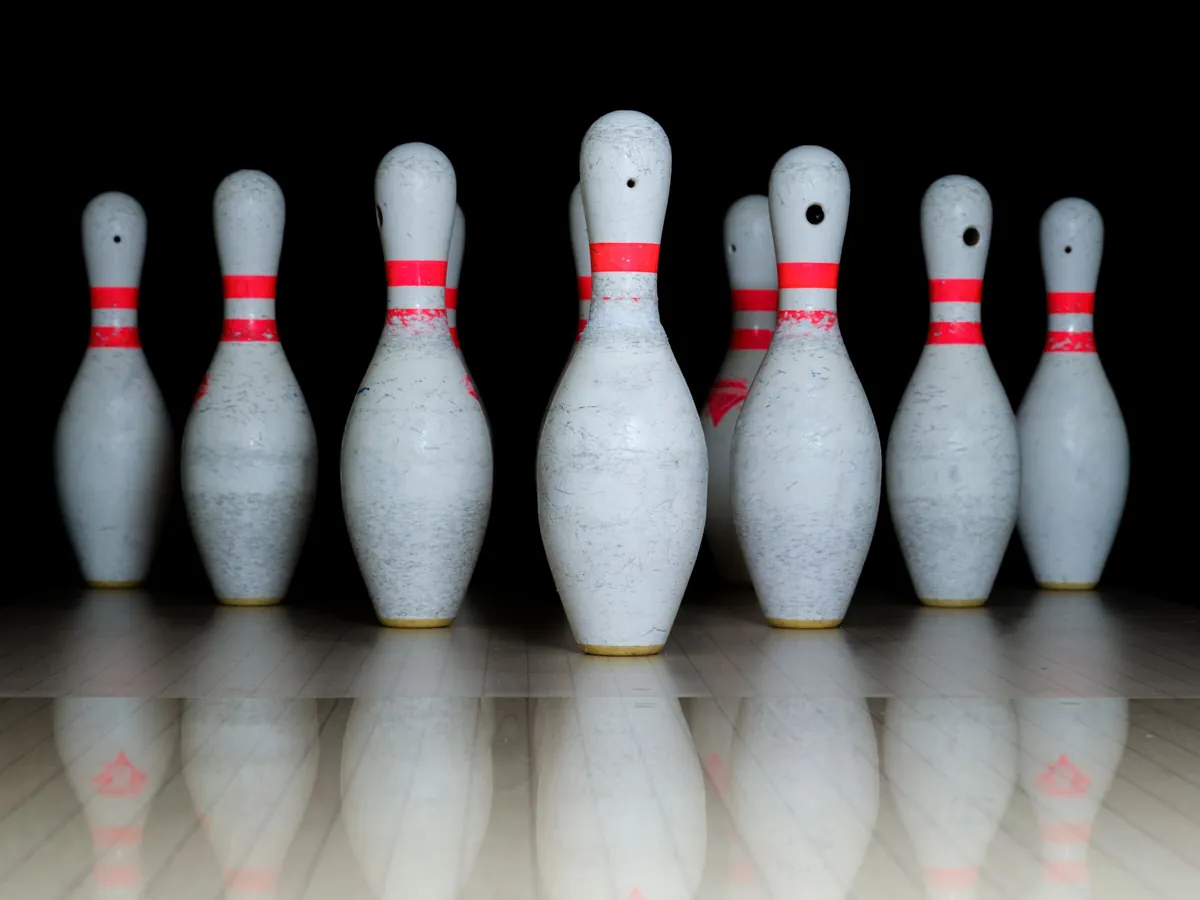
A regulation bowling pin is 38.1 cm (15 in) tall and weighs between 1.53 and 1.64 kg (3 lb 6 oz to 3 lb 10 oz). Its maximum diameter, at the “belly”, is about 12.1 cm (4.766 in). It is traditionally made of hard maple glued together from several blocks, then covered with a tough plastic coating and painted white with two red stripes around the neck. Fully synthetic pins also exist.
| Specification | Value |
|---|---|
| Height | 38.1 cm (15 in) |
| Weight | 1.53 to 1.64 kg |
| Maximum diameter | ≈ 12.1 cm (4.766 in) |
| Distance between centres of neighbouring pins | 30.5 cm (12 in) |
| Number of pins | 10 |
The ten pins form an equilateral triangle, pointing towards the bowler, in four rows: the 1-pin at the front, then 2-3, 4-5-6 and 7-8-9-10 at the back. For a bowler facing the pins, the 7-pin is at the back left and the 10-pin at the back right. The numbers are used to describe leaves and splits; they are explained in the bowling glossary. For comparison, the ball measures at most 21.83 cm in diameter and weighs no more than 7.26 kg (16 lb).
How are the pins reset?
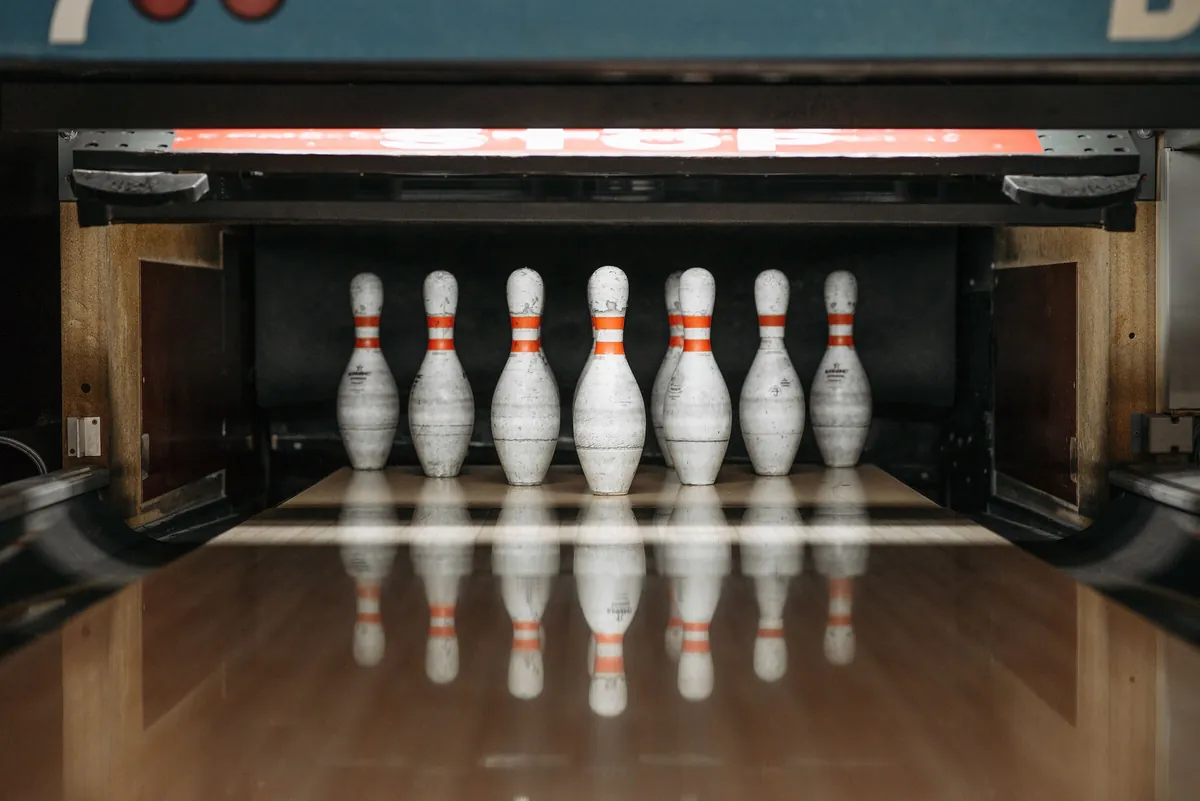
The pins are collected and reset by a machine called a pinsetter. There are two main types.
The free-fall pinsetter
This is the classic machine found in competition centres: it sweeps the fallen pins into the pit, lifts them back up, sorts them and sets them down one by one on their spots. The pins are completely free during the delivery. The first automatic machines, developed by AMF from the late 1940s onwards, replaced the human “pinsetters” (pin boys), often young boys, who reset the pins by hand. These machines made the growth of large bowling centres possible.
The string pinsetter
In a string pinsetter, each pin is attached at the top to a cord. After the delivery, the machine pulls the cords to lift the pins and set them back down. These machines are cheaper to buy and maintain, use less energy and break down less often; they have become very widespread in leisure centres.
The strings slightly change the way the pins behave, which has sparked debate among bowlers. In April 2023, the USBC announced that it would certify bowling on string pinsetters as a separate competition category, from 1 August 2023. Its later studies concluded that averages remained comparable, even though scores are generally slightly lower than on free-fall machines.
Where can you try a real lane in Morocco?
In Morocco, bowling lanes are found mainly in leisure centres and shopping centres in the major cities. Their features (number of lanes, type of pinsetter, opening hours) are listed in the directory of bowling centres in Morocco, with dedicated pages for Casablanca, Rabat and Marrakech.
To bowl in a competitive setting, with a proper oil pattern and competition rules, get in touch with the ASBM (Association Sportive du Bowling Marocain, the Moroccan Bowling Sports Association), the pioneer of bowling in Morocco since 2007, which runs a weekly league at the Megamall in Rabat.
Frequently asked questions
How long is a bowling lane?
A bowling lane measures 18.29 m (60 ft) from the foul line to the centre of the headpin (1-pin). Up to the pit at the far end, the length reaches about 19.16 m.
How wide is a bowling lane?
A lane is about 1.05 m (41.5 in) wide, divided into 39 boards. On top of that there is a gutter about 23.5 cm wide on each side.
How much does a bowling pin weigh?
A regulation pin weighs between 1.53 and 1.64 kg (3 lb 6 oz to 3 lb 10 oz) and stands 38.1 cm tall.
What are the arrows on a bowling lane for?
The seven arrows, located between about 3.7 and 4.9 m from the foul line, are used as an aiming target. It is easier to aim at a nearby arrow than at pins more than 18 m away.
What is a string pinsetter?
It is a machine in which each pin is attached to a cord that is used to lift it and set it back in place. Cheaper to maintain than the classic pinsetter, it is very common in leisure centres.
What are bowling pins made of?
Pins are traditionally made of hard maple, covered with a plastic coating and painted white with red stripes. Fully synthetic pins also exist.