Key points
- Ten-pin bowling is the global form: 2 balls per frame, a ball with finger holes weighing up to 16 lb (7.26 kg), a maximum score of 300.
- Nine-pin is played with the pins in a diamond and a ball without holes, mainly in Germany, Austria and the Czech Republic.
- Candlepin and duckpin use small balls and 3 balls per frame; no 300 has ever been sanctioned in either.
- Canadian five-pin gives each pin a value (15 points per frame) for a maximum of 450.
- Lawn bowls has nothing to do with pins: players roll balls towards a small target ball, as in pétanque.
How many types of bowling are there?
There are about half a dozen organised forms of bowling, all based on the same principle: rolling a ball to knock down pins. They differ in the number and shape of the pins, the size of the ball, the number of balls per frame and the way points are scored. The table below summarises the main ones.
| Variant | Where it is played | Pins | Ball | Balls per frame | Max. score |
|---|---|---|---|---|---|
| Ten-pin | Worldwide (including Morocco) | 10 | Up to 7.26 kg, 3 holes | 2 | 300 |
| Nine-pin | Germany, Austria, Central Europe | 9 | About 2.85 kg, no holes | Depends on the discipline | — |
| Candlepin | New England, Canada's Maritime provinces | 10 | Under 1.1 kg, held in the hand | 3 | 300 (never achieved) |
| Duckpin | East Coast of the United States | 10 | 1.53 to 1.70 kg, no holes | 3 | 300 (never achieved) |
| Five-pin | Canada | 5 | Small rubber ball | 3 | 450 |
Ten-pin bowling, the global standard
Ten-pin bowling is the variant played in virtually every leisure centre in the world, including all the bowling centres in Morocco. It is also the only one governed by the International Bowling Federation and played in international competition.
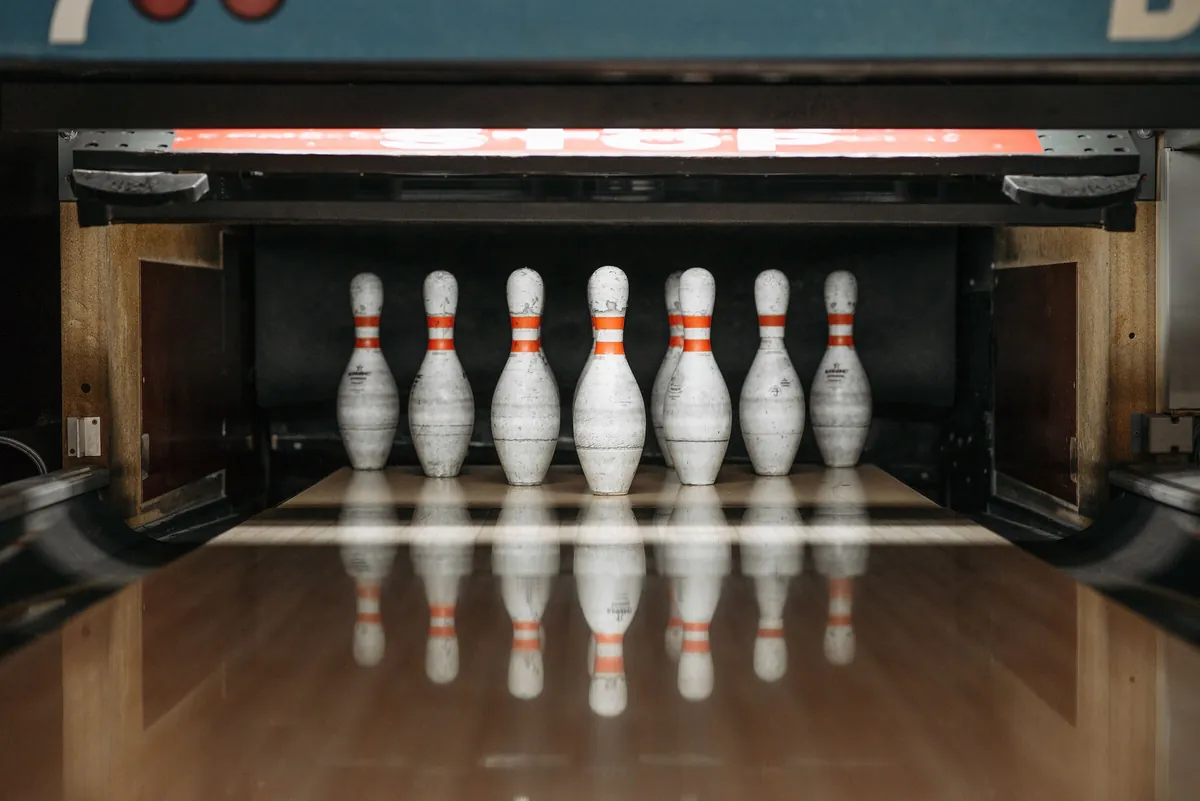
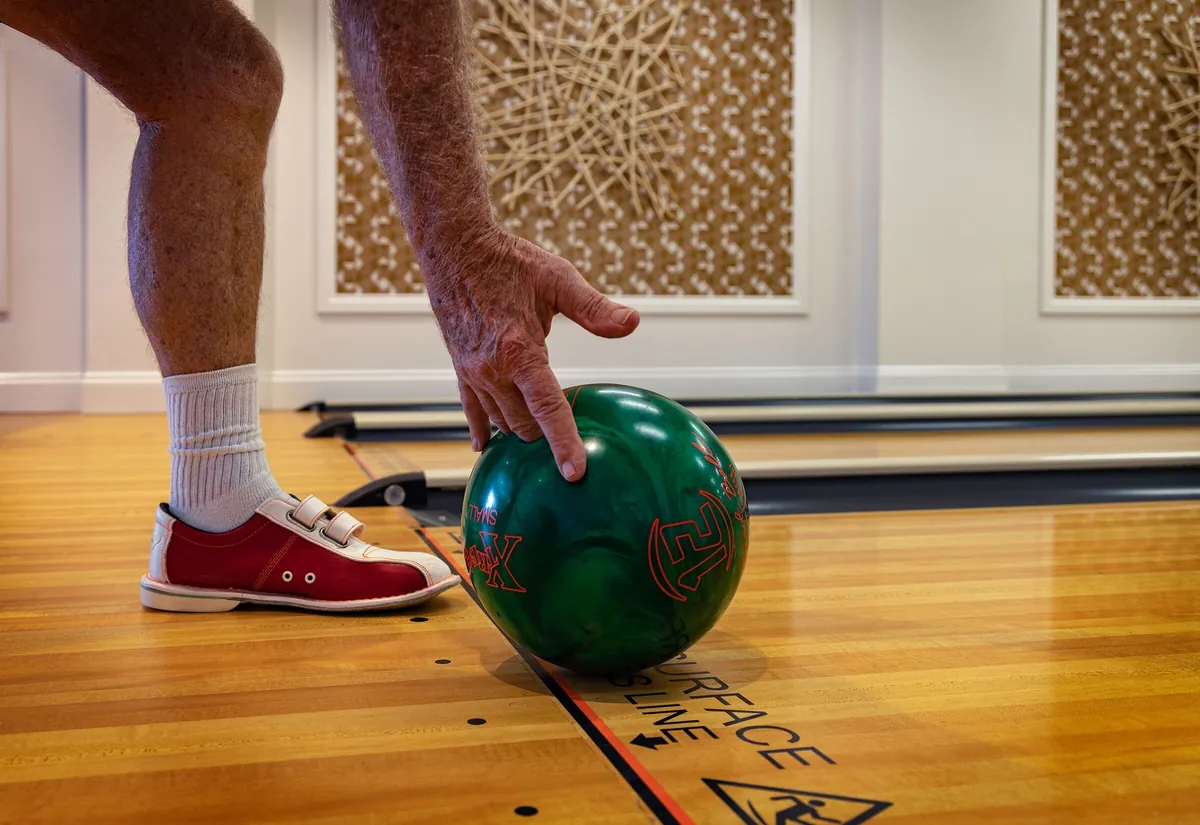
Its specifications are standardised: 10 pins 38.1 cm tall set out in a triangle, a lane 18.29 m long from the foul line to the headpin, a ball of no more than 16 lb (7.26 kg) drilled with finger holes, two balls per frame, 10 frames per game and a maximum score of 300. Fallen pins are cleared between the two balls. For details, see our guides to the rules of bowling and to lanes and pins.
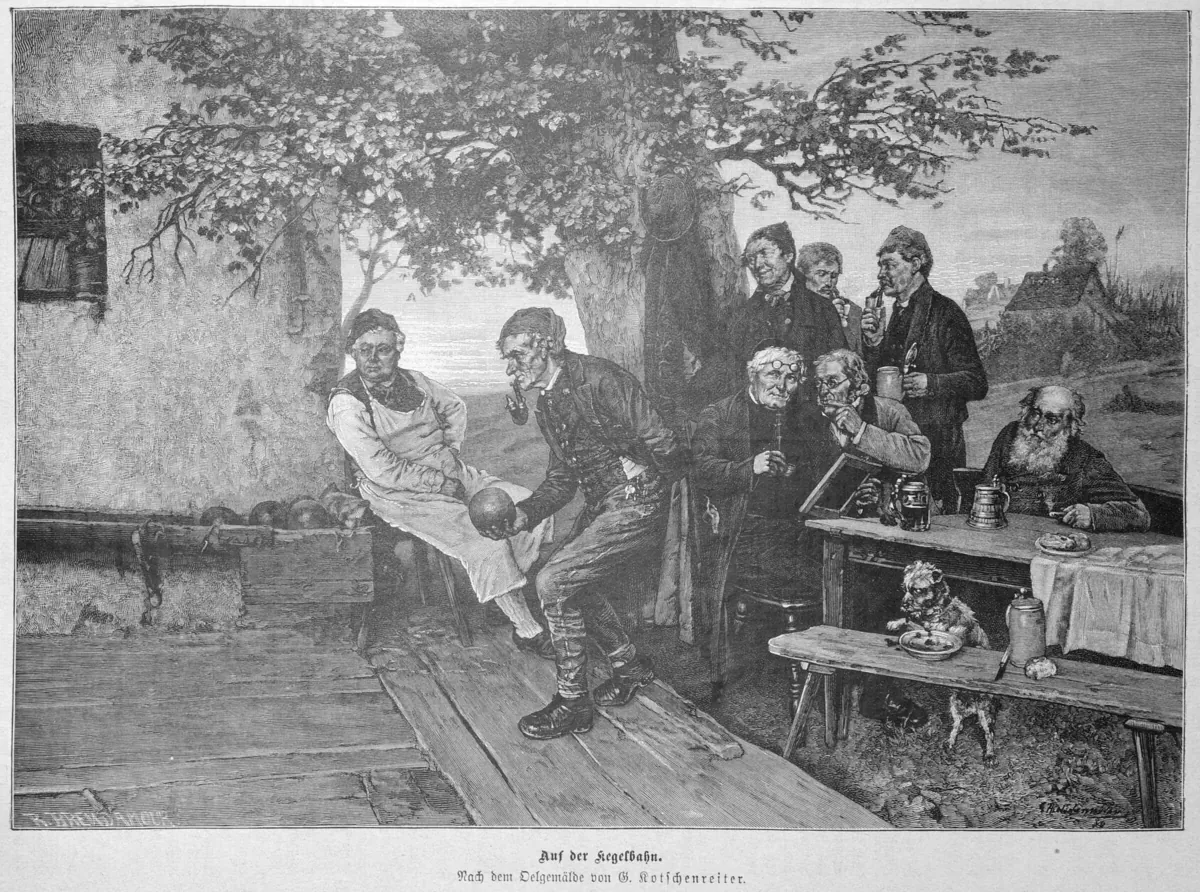
Nine-pin bowling (Kegeln)
Nine-pin bowling is the direct ancestor of ten-pin and remains a thriving sport in Central Europe. The nine pins are set out in a diamond and the ball, about 16 cm in diameter and weighing 2.85 kg, usually has no holes: you hold it in the palm of your hand. Two-hole balls exist for beginners.
The discipline has about 130,000 players, mainly in Germany, Austria and the Czech Republic. There are several types of lane: the “classic” lane of 19.5 m, the most common, and regional variants such as the Bohle (23.5 m) or the Schere. In the United States, nine-pin survives in a few communities of German origin in Texas. It was its ban in several US states in the 19th century that is said to have fuelled the rise of ten-pin, as told in our history of bowling.
Candlepin: small balls and candle-shaped pins
Candlepin is a North American variant that originated around 1880 in Worcester, Massachusetts, and is played mainly in New England and Canada's Maritime provinces. The pins are tall and thin, almost cylindrical, like candles, hence the name. The ball measures about 11.4 cm in diameter and weighs no more than 2 lb 7 oz (about 1.1 kg), barely more than a pin.
Players get three balls per frame, and fallen pins stay on the lane between balls: this “dead wood” can be used to knock down the remaining pins. It is fiendishly difficult: the theoretical maximum score is 300, but the sanctioned record is only 245, achieved in 1984 and again in 2011.
Duckpin: ten-pin in miniature
Duckpin uses the same triangular layout as ten-pin, but with shorter, lighter pins and a ball without holes, 12.1 to 12.7 cm in diameter and weighing between 1.53 and 1.70 kg. As in candlepin, you get three balls per frame, but fallen pins are cleared away.
Duckpin is played mainly in the Mid-Atlantic states of the US East Coast (Maryland, Connecticut, Rhode Island…). No 300 has ever been sanctioned: the record is 279, set by Pete Signore Jr. in 1992.
Canadian five-pin bowling
Five-pin bowling is a Canadian invention: Thomas F. Ryan created it around 1909 at his club in Toronto, for customers who found ten-pin too physically demanding. He reduced the pins to about three-quarters of their size and used hard rubber balls that fit in the hand.
What makes it special is the scoring: each pin has a value depending on its position, 5 points for the centre pin, 3 points for each of the two middle pins and 2 points for each of the two corner pins, making 15 points per frame. With three balls per frame and 12 strikes, the maximum score is 450. Five-pin is the dominant form of bowling in most of English-speaking Canada.
String pin bowling: same game, different machine
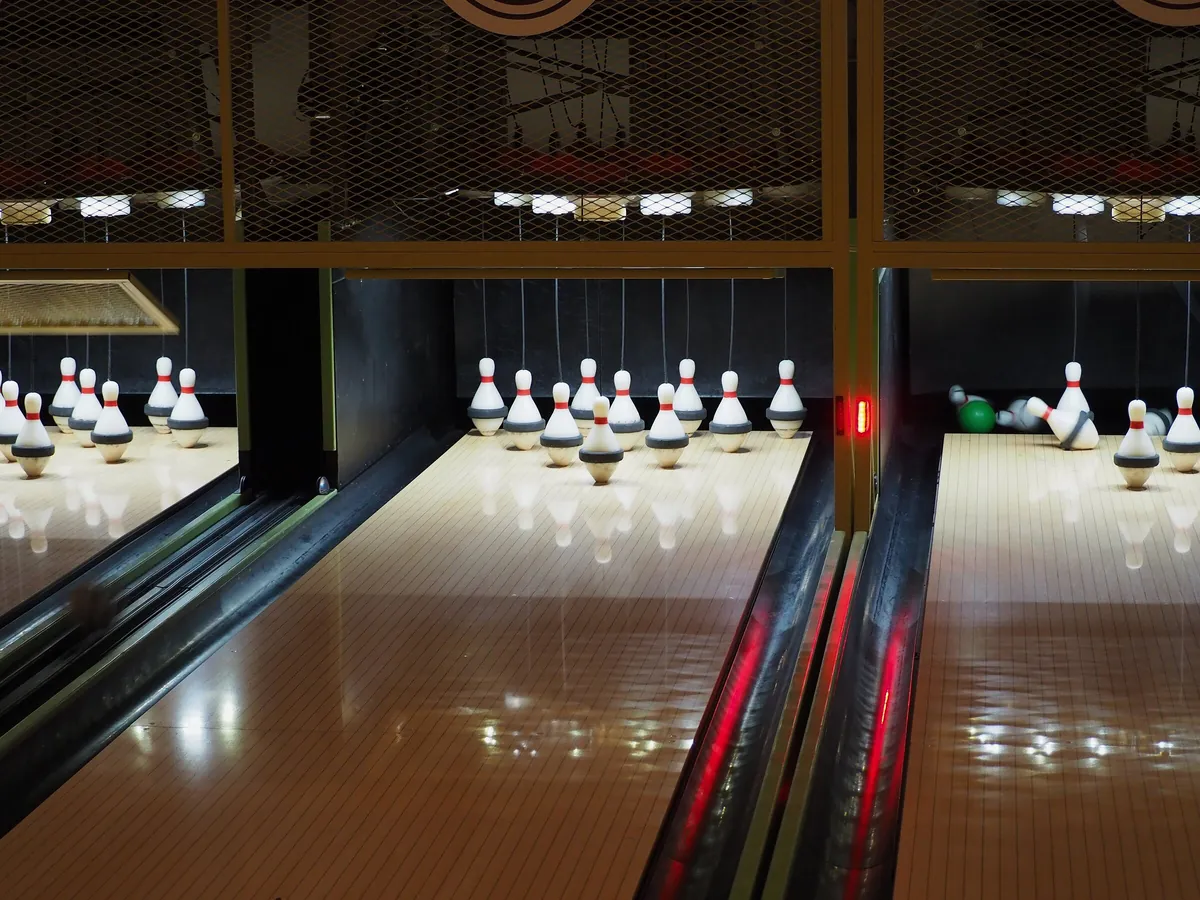
String pin bowling (played on a string pinsetter) is not really a variant of the game, but a different pin-setting technology. Instead of a “free-fall” machine that picks up and resets the pins, each pin is attached by a string to the machine, which lifts it up and lowers it back down. These machines are cheaper to buy and maintain, which explains their success in leisure centres, including recently opened ones.
The difference is not trivial: tethered pins don't fall or bounce in exactly the same way as free pins. That is why the USBC decided to certify string pin bowling as a separate competition category from 1 August 2023, with its own specifications (a minimum string length of 54 inches).
For a casual game with friends, the difference is barely noticeable. For a league bowler tracking their average, it is worth knowing what type of machine you are bowling on.
Bowling and lawn bowls: what's the difference?
Lawn bowls (or simply bowls) is a completely different sport, despite the similar name. It is played outdoors on closely mown grass or an artificial surface, without pins: players roll asymmetric balls, which follow a curved path, to place them as close as possible to a small target ball, the jack. It is therefore closer to pétanque or boule lyonnaise than to the bowling played in our centres.
It is very popular in the United Kingdom, Australia, New Zealand and South Africa, and is part of the Commonwealth Games programme. If you are looking for a game of ten-pin bowling near you, check out our pages on bowling in Casablanca and bowling in Marrakech instead.
Frequently asked questions
What is the difference between bowling and skittles?
Bowling is a codified form of skittles. Modern bowling is most often played with 10 pins in a triangle, whereas traditional European skittles games often use 9 pins in a diamond.
What is candlepin bowling?
It is a variant that originated around 1880 in Massachusetts, played with thin pins and a small ball weighing about 1 kg. You get three balls per frame and fallen pins stay on the lane.
How do you keep score in five-pin bowling?
The centre pin is worth 5 points, the two middle pins 3 points each and the two corner pins 2 points each, making 15 points per frame and 450 at most.
Is string pin bowling real bowling?
Yes, the rules are those of ten-pin, but the pins are attached to the machine. In 2023 the USBC recognised it as a separate competition category, because the pins do not react in exactly the same way as free pins.
Is lawn bowls the same thing as bowling?
No. Lawn bowls is played outdoors without pins: you roll balls to get them as close as possible to a small target ball, as in pétanque.